Category: CPF Matters

  • What Happens to Your CPF When You Pass Away? A Guide for Families

    When a loved one passes away, the last thing most families want to think about is paperwork. But understanding what happens to their CPF savings can save you months of confusion and unnecessary stress.

    CPF money doesn’t automatically go to the next of kin. It doesn’t follow your will either. The process depends entirely on whether the deceased made a CPF nomination, and many Singaporeans don’t realise this until it’s too late.

    Key Takeaway

    When someone dies, their CPF savings are distributed based on their nomination. If no nomination exists, the money goes through intestacy laws or the Public Trustee’s Office. Nominees can claim within 15 days, while non-nominated estates may take months. Making a nomination is the single most important step to protect your family from delays and legal complications.

    CPF savings don’t follow your will

    Most people assume their CPF will be distributed according to their will. That’s wrong.

    CPF savings are not part of your estate. They sit outside the usual inheritance process.

    If you made a CPF nomination, your money goes directly to the people you named. No probate. No waiting for lawyers.

    If you didn’t make a nomination, the CPF Board distributes your savings according to intestacy laws or through the Public Trustee’s Office. This can take much longer and may not match your wishes.

    Your will controls your property, bank accounts, and investments. But CPF follows its own rules.

    Three ways CPF gets distributed after death

    The distribution path depends on what you did while alive.

    If you made a CPF nomination

    Your savings go directly to the people you named. You can nominate family members like your spouse, children, parents, or siblings.

    The CPF Board contacts nominees within 15 days of receiving the death certificate. The process is straightforward and usually completed within weeks.

    If you didn’t make a nomination and your estate is small

    For estates under $50,000, the Public Trustee’s Office handles distribution. They follow intestacy laws, which prioritise spouse and children.

    This process takes longer, often several months. There are also administrative fees involved.

    If you didn’t make a nomination and your estate is large

    For estates above $50,000, your family needs to apply for a Grant of Probate or Letters of Administration. Only then can they claim your CPF savings.

    This is the slowest route. It can take six months to over a year, depending on the complexity of your estate.

    Who can you nominate for your CPF

    You can’t just name anyone. CPF nominations are restricted to immediate family.

    Eligible nominees include:

    • Your spouse
    • Your children (including legally adopted children)
    • Your parents
    • Your siblings

    You cannot nominate friends, distant relatives, or charities. If you want to leave money to them, you’ll need to do it through your will, not CPF.

    You can split your CPF savings among multiple nominees. For example, 50% to your spouse and 25% each to two children.

    You can also specify different nominees for different CPF accounts. Some people leave their Ordinary Account to their spouse and their Special Account to their children.

    How to make a CPF nomination

    There are three types of nominations, and they work differently.

    Nomination Type Can Be Revoked? Witnessed? Best For
    Revocable Yes, anytime No witness needed Most people who want flexibility
    Irrevocable No, it’s permanent Requires two witnesses Those who want certainty for specific beneficiaries
    Revocable with Partial Irrevocable Mixed Witnesses for irrevocable portions Blended families or complex situations

    Making a revocable nomination

    This is the most common choice. You can change it whenever your circumstances change.

    Log in to your Singpass account on the CPF website. Go to “My Requests” and select “Nomination of CPF Savings”. Fill in your nominees and their shares.

    You can update it online anytime. No paperwork. No witnesses.

    Making an irrevocable nomination

    Once you make this, you can’t change it. Even if you divorce or your relationship changes, the nomination stays.

    You need to download the form from the CPF website, fill it in, and have two witnesses sign it. Then mail it to the CPF Board.

    Most people don’t need this unless they want absolute certainty for a specific person, like a special needs child.

    The claim process for nominees

    When someone passes away, the CPF Board doesn’t automatically release the money. Nominees need to take action.

    Step 1: Report the death

    The death must be registered with the Immigration and Checkpoints Authority. This usually happens through the hospital or funeral director.

    The CPF Board receives this information automatically through government systems.

    Step 2: Wait for the CPF Board to contact you

    Within 15 days, the CPF Board will send a letter to all nominees at their registered addresses.

    The letter explains what you need to do and includes claim forms.

    If you don’t receive a letter within three weeks, contact the CPF Board directly.

    Step 3: Submit your claim

    You’ll need to provide:

    1. Your identity card
    2. The deceased’s death certificate
    3. Completed claim forms

    You can submit these online through Singpass or visit a CPF Service Centre.

    Step 4: Receive the payout

    Once your documents are verified, the money is transferred directly to your bank account.

    For straightforward cases, this takes about two to four weeks from submission.

    What happens if there’s no nomination

    This is where things get complicated and slow.

    The CPF Board cannot release the money to family members without legal authority. They need proof that you’re entitled to the savings.

    For estates under $50,000

    Your family can apply to the Public Trustee’s Office. You’ll need:

    • The death certificate
    • Proof of relationship (birth certificates, marriage certificate)
    • Identity documents for all beneficiaries

    The Public Trustee charges a fee based on the estate value. For a $30,000 CPF balance, the fee is around $15 plus 2.4% of the amount.

    Processing time is typically three to six months.

    For estates above $50,000

    You need to apply for a Grant of Probate (if there’s a will) or Letters of Administration (if there’s no will) from the Family Justice Courts.

    This involves:

    1. Filing court documents
    2. Paying court fees
    3. Waiting for the grant to be issued
    4. Using the grant to claim CPF savings

    Many families hire a lawyer for this. Legal fees can range from $3,000 to $10,000 depending on complexity.

    The entire process often takes six to twelve months.

    Making a CPF nomination is free and takes less than 10 minutes online. Not making one can cost your family thousands in legal fees and months of waiting. There’s no good reason to delay this.

    Common mistakes families make

    Assuming the spouse automatically gets everything

    Even if you’re married, your spouse doesn’t automatically receive your CPF savings without a nomination.

    Under intestacy laws, if you have children, your spouse only gets 50%. The other 50% is split among your children.

    If you want your spouse to receive everything, you must make a nomination stating that.

    Forgetting to update nominations after major life events

    Your nomination doesn’t automatically update when you get married, divorced, or have children.

    If you nominated your parents 20 years ago and never updated it, your spouse and children might not receive anything.

    Review your nomination every few years or after significant life changes.

    Not telling family members about the nomination

    Some people make nominations but never tell their family. When they pass away, relatives don’t know the nomination exists and start the lengthy non-nomination process unnecessarily.

    Tell your nominees that you’ve named them. You don’t have to share the amounts, just let them know they’re included.

    Mixing up CPF and will provisions

    Some people write in their will that their CPF should go to specific people. This has no legal effect.

    CPF nominations override anything in your will. Keep them separate in your mind and your planning.

    Special situations that affect CPF distribution

    If a nominee dies before you

    The deceased nominee’s share doesn’t go to their children or spouse. It goes back into the pool and is redistributed among your remaining nominees.

    If you only had one nominee and they die before you, your CPF becomes non-nominated and follows intestacy laws.

    If you’re going through a divorce

    Your CPF nomination remains valid even during divorce proceedings. It only changes if you actively revoke or update it.

    After a divorce is finalised, update your nomination immediately. Your ex-spouse doesn’t automatically get removed.

    If you have minor children

    You can nominate children under 18. If you pass away before they turn 18, the Public Trustee holds their share in trust until they reach adulthood.

    The Public Trustee may release small amounts for the child’s maintenance and education before then.

    If a nominee can’t be found

    The CPF Board makes reasonable efforts to contact nominees. If someone can’t be located after multiple attempts, their share is held by the CPF Board.

    The nominee can claim it later, even years after your death, once they come forward with proper identification.

    How CPF Life payouts work after death

    If you were already receiving CPF Life monthly payouts when you passed away, the remaining balance in your Retirement Account still gets distributed.

    The amount depends on your CPF Life plan and how long you received payouts.

    Your nominees receive whatever is left in your Retirement Account after your death. If you chose the Basic Plan, there might be a substantial amount remaining. If you chose the Escalating Plan, the remaining balance is typically smaller.

    The monthly payouts stop immediately upon death. There’s no final partial month payment.

    CPF MediSave and Special Account balances

    All your CPF accounts are included in the distribution, not just your Ordinary Account.

    Your MediSave, Special Account, and Retirement Account balances all go to your nominees or through the non-nomination process.

    For many retirees and Merdeka Generation members, the MediSave account often has a significant balance because it can’t be withdrawn as easily as other accounts. Understanding how to maximise your MediShield Life coverage as a Merdeka Generation senior while you’re alive ensures these savings serve their purpose.

    Tax implications for beneficiaries

    Good news here. CPF payouts to beneficiaries are not considered taxable income in Singapore.

    You don’t need to declare the money you receive from a deceased person’s CPF on your tax return.

    There’s also no estate duty in Singapore since it was abolished in 2008.

    Practical steps to take today

    If you haven’t made a CPF nomination yet, do it this week. Log in to your Singpass account and complete it online. It takes less time than making a cup of coffee.

    If you made a nomination years ago, check if it still reflects your current wishes. Life changes. Your nomination should too.

    If you’re helping elderly parents with their estate planning, sit down with them and walk through the CPF nomination process together. Many seniors put this off because they find the online system confusing. Helping your parents claim all their Merdeka Generation benefits includes making sure their CPF nominations are current.

    Tell your family that you’ve made a nomination. You don’t need to share the details if you prefer privacy, but let them know it exists so they don’t waste time and money on unnecessary legal processes.

    Keep a copy of your nomination confirmation in a safe place where your family can find it. Some people keep it with their insurance documents or in a folder labelled “Important Papers”.

    Making sure your family is protected

    CPF represents decades of savings for most Singaporeans. For Merdeka Generation members especially, it’s often the largest financial asset they’ll leave behind.

    The difference between having a nomination and not having one is measured in months of waiting and thousands of dollars in fees. One takes 10 minutes online. The other takes half a year and a lawyer.

    Your family will already be dealing with grief. Don’t add financial confusion and legal complications to their burden. A simple nomination today prevents all of that tomorrow.

    Check your CPF nomination status this week. Update it if needed. Tell someone you trust that it exists. These three small actions protect the people you care about most.


  • Understanding Your CPF LIFE Monthly Payout: Why the Amount Changes

    Understanding Your CPF LIFE Monthly Payout: Why the Amount Changes

    You check your bank account on the first of the month and notice your CPF LIFE payout is different from last month. Again. You’re not imagining things, and you’re definitely not alone. Many Singaporean retirees find themselves puzzled when their monthly payouts don’t stay constant, even though they were told these payments would be for life.

    Key Takeaway

    Your CPF LIFE payout fluctuates due to interest earned on your remaining balance, bonus interest from government schemes, adjustments to your chosen plan, and annual inflation adjustments. These changes are normal and designed to help your retirement income keep pace with rising costs. Understanding these factors helps you plan your monthly budget more accurately and avoid unnecessary worry about payment variations.

    The main reasons your monthly payout amount shifts

    CPF LIFE payouts are not set in stone. They adjust based on several factors that work together to determine what lands in your account each month.

    Your Retirement Account (RA) balance continues to earn interest even after payouts begin. This interest gets added to your balance, which then affects your future payout calculations. Think of it like a water tank that’s slowly being drained but also receives small top-ups from rain. The more water (interest) that flows in, the longer your tank lasts, and the calculation adjusts accordingly.

    The CPF Board recalculates your payout annually based on your remaining balance and projected lifespan. As you age, the calculation changes because there are fewer expected years of payouts ahead. This doesn’t mean you’ll receive less overall. It means the system is redistributing your remaining balance across your remaining years.

    Government schemes like the Matched Retirement Savings Scheme can also boost your RA balance. When your balance increases, your monthly payout typically increases too. This is good news, but it can surprise people who weren’t expecting the change.

    How interest earnings affect your monthly amount

    Interest on your RA balance plays a bigger role than most people realise. Your RA earns up to 6% per annum on the first $30,000 and 5% on the next $30,000. After that, it earns 4% per annum.

    These interest earnings don’t just sit idle. They get factored into your payout calculations. The CPF Board reviews your balance and interest earned, then adjusts your payout to reflect the new total.

    Here’s a practical example. Let’s say you have $150,000 in your RA when payouts begin. Over the year, you earn interest on the remaining balance after each month’s payout. By the time the annual review comes around, you’ve accumulated several thousand dollars in interest. The system then recalculates your monthly payout based on this higher balance.

    This is why some retirees see their payouts increase slightly year after year, especially in the early years of retirement when their RA balance is still substantial.

    Understanding the three CPF LIFE plans and their impact

    The plan you chose makes a significant difference in how your payouts behave over time.

    Standard Plan provides consistent monthly payouts that remain relatively stable throughout your retirement. Most people choose this plan because it’s predictable and easier to budget around.

    Escalating Plan starts with lower payouts that increase by 2% annually to keep pace with inflation. If you’re on this plan, your payout will definitely change every year. That’s by design. The trade-off is that your purchasing power stays more consistent as prices rise.

    Basic Plan offers the highest initial payouts but leaves a larger bequest to your beneficiaries. Your monthly amount can still fluctuate based on interest and other factors, but the starting point is higher than the other two plans.

    Many retirees forget which plan they selected years ago. If you’re unsure, log into your CPF account or call the CPF hotline at 6227 1188. Knowing your plan helps you understand whether your payout changes are expected or unusual. You might also want to check if you qualify for the Merdeka Generation Package, which provides additional healthcare subsidies that complement your CPF LIFE income.

    Annual adjustments and inflation protection

    CPF LIFE includes built-in mechanisms to protect your purchasing power. Every year, the CPF Board reviews payout rates based on updated mortality projections and interest rate assumptions.

    These adjustments might increase or decrease your payout slightly, depending on how the calculations work out. For Escalating Plan members, the 2% annual increase is automatic. For Standard and Basic Plan members, adjustments are less predictable but generally trend upward over time due to accumulated interest.

    Inflation protection matters more than you might think. A $1,000 monthly payout today won’t buy the same amount of groceries or pay the same utility bills ten years from now. The system tries to account for this by adjusting payouts periodically.

    Government top-ups and bonus schemes

    The government occasionally introduces schemes that boost CPF balances. The GST Voucher scheme, for instance, can credit money directly into your account. Workfare Income Supplement payments for older workers also go into CPF accounts.

    When these top-ups happen, your RA balance increases. At the next annual review, your payout gets recalculated based on the new higher balance. This can result in a pleasant surprise when you see a bigger number in your bank account.

    Some retirees worry these changes indicate an error. They don’t. They’re actually working in your favour. The system is designed to distribute any additional funds across your remaining retirement years.

    How withdrawals before payout age affect your amount

    If you made any withdrawals from your RA before your payout start date, those withdrawals directly reduced your starting balance. A lower starting balance means lower monthly payouts.

    This is why maximising your CPF Retirement Account before payouts begin makes such a difference. Every dollar you withdraw early is a dollar that won’t generate interest and won’t contribute to your monthly income later.

    Some people withdrew funds at 55 for home renovations or other expenses. Others pledged their CPF for property purchases and never fully refunded the amount. These past decisions continue to affect your current payout amount.

    Checking your payout history and spotting patterns

    You can track your payout changes by reviewing your CPF statements. Log into your account at cpf.gov.sg and check your transaction history. You’ll see each month’s payout amount listed clearly.

    Look for patterns. Do your payouts increase every January? That might be the annual adjustment. Did you receive a one-time boost in a particular month? That could be a government top-up or interest credit.

    Understanding these patterns helps you budget better. If you know your payout typically increases by $20 to $30 each year, you can plan for that. If you know certain months might have variations due to interest calculations, you won’t panic when the amount differs slightly.

    What you can do to stabilise or increase your payout

    You have some control over your CPF LIFE payout, even after it starts.

    1. Make voluntary top-ups to your RA using cash. This increases your balance and triggers a payout recalculation.
    2. Transfer funds from your Ordinary or Special Account to your RA if you still have balances there.
    3. Defer your payout start date if you haven’t begun receiving payments yet. Starting later means higher monthly amounts.
    4. Consider whether topping up your CPF LIFE after 65 makes sense for your situation.

    Each of these actions has trade-offs. Topping up means less cash on hand now but more income later. Deferring payouts works only if you have other income sources to cover your expenses in the meantime.

    Common mistakes that lead to confusion

    Many retirees make the same errors when trying to understand their payouts.

    Mistake Why it happens How to avoid it
    Expecting identical amounts every month Misunderstanding how interest and adjustments work Review annual statements and understand your plan type
    Forgetting past withdrawals Not connecting old decisions to current payouts Check your CPF transaction history from age 55 onwards
    Ignoring government top-ups Not realising these affect your balance Read CPF notifications and emails carefully
    Comparing payouts with friends Everyone’s balance and plan differs Focus on your own situation, not others’
    Assuming errors without checking Panicking instead of investigating Log into your account or call CPF before worrying

    The common mistakes Merdeka Generation seniors make when claiming benefits often extend to understanding CPF LIFE payouts too. Taking time to review your statements prevents unnecessary stress.

    When to contact CPF about your payout

    Most payout variations are normal. But sometimes you should reach out to CPF directly.

    Contact them if:

    • Your payout suddenly drops by a large amount (more than 10%) without explanation
    • You haven’t received a payout for two consecutive months
    • The amount credited doesn’t match the amount stated in your CPF letter
    • You made a voluntary top-up but see no adjustment after three months
    • You switched plans but your payout doesn’t reflect the change

    The CPF hotline (6227 1188) operates on weekdays from 8am to 6pm. Have your NRIC ready when you call. The staff can pull up your account and explain exactly why your payout changed.

    You can also visit a CPF Service Centre if you prefer face-to-face assistance. Bring your NRIC and any relevant documents, like bank statements showing the payment amounts you’re questioning.

    How your chosen payout start date plays a role

    When you chose to start receiving payouts affects not just the amount but also how future adjustments work.

    Starting at 65 gives you the standard payout rate. Starting later (up to age 70) increases your monthly amount because the system expects to pay you for fewer years. Starting earlier than 65 is no longer an option for most people under current rules.

    If you withdrew your CPF savings at 65 instead of letting them compound, you’re now receiving lower payouts than you could have. This decision can’t be reversed, but understanding it helps you plan better going forward.

    Planning your budget around variable payouts

    Since your CPF LIFE payout can change, smart budgeting accounts for this variability.

    Base your essential expenses (utilities, groceries, insurance) on your lowest expected payout. Treat any increases as bonus money that can go toward discretionary spending or savings.

    Keep a buffer fund of at least three months’ expenses in a separate savings account. This cushion protects you if your payout decreases unexpectedly or if you face an emergency.

    Track your payouts in a simple spreadsheet or notebook. Write down each month’s amount and any patterns you notice. Over time, you’ll develop a clear picture of your income trends.

    Consider how your healthcare needs might change as you age. The MediShield Life coverage available to Merdeka Generation seniors helps with medical costs, but you’ll still have out-of-pocket expenses to budget for.

    Comparing Standard versus Escalating Plan outcomes

    The plan comparison matters more over time than in the first few years.

    Standard Plan keeps your payout relatively stable. You might see small increases from interest, but the monthly amount won’t jump dramatically. This predictability helps with budgeting but means your purchasing power gradually erodes as prices rise.

    Escalating Plan increases your payout by 2% annually. In year one, you receive less than the Standard Plan. By year 15 or 20, you’re receiving significantly more. The crossover point depends on your starting balance and age.

    If you’re trying to decide between plans or wondering if you chose correctly, read about which payout suits your retirement better. The right choice depends on your health, other income sources, and spending patterns.

    “Many retirees underestimate how much inflation affects their purchasing power over a 20 or 30-year retirement. A plan that seems to pay less now but increases over time often provides better long-term security.” — Financial Planning Association of Singapore

    What happens if you’re married or have dependants

    Your CPF LIFE payout is yours alone. It doesn’t automatically extend to your spouse or children. However, your remaining RA balance goes to your beneficiaries when you pass away, assuming you haven’t depleted it completely.

    If your spouse also receives CPF LIFE, you’re managing two separate income streams. Their payout changes independently of yours based on their own balance, plan, and circumstances.

    Some couples try to coordinate their payout start dates or plan choices to optimise household income. For example, one spouse might choose the Standard Plan for stability while the other chooses Escalating for inflation protection. This strategy spreads risk and provides a more balanced income over time.

    Understanding whether your spouse can enjoy Merdeka Generation benefits if only you qualify helps you plan household finances more comprehensively.

    Real examples of payout changes

    Let’s look at three real scenarios (names changed for privacy).

    Mr Tan, 67, Standard Plan: Started with $1,280 per month. After one year, his payout increased to $1,295 due to interest earned. The following year, it went up to $1,308. These small increases reflect the interest on his remaining balance.

    Mdm Lee, 66, Escalating Plan: Started with $1,050 per month. One year later, her payout increased to $1,071 (the 2% escalation). Two years in, it reached $1,092. She also received a $50 increase one year due to a government top-up scheme.

    Mr Kumar, 70, Basic Plan: Started with $1,450 per month. His payout stayed relatively stable for two years, then increased by $35 after he made a $10,000 voluntary top-up to his RA.

    These examples show that changes are normal and often work in your favour. The key is understanding why they happen so you’re not caught off guard.

    Making sense of your annual CPF statement

    Your annual CPF statement arrives around your birthday each year. It contains valuable information about your payouts.

    Look for the section that shows your RA balance at the start and end of the year. Compare these figures to see how much you received in payouts versus how much interest you earned.

    Check the projected payout amount for the coming year. CPF provides an estimate based on current calculations. This number helps you budget for the year ahead.

    Review any transactions listed. Top-ups, interest credits, and special schemes all appear here. If something looks unfamiliar, don’t ignore it. Call CPF or visit a service centre to ask.

    Helping elderly parents understand their payouts

    If you’re reading this to help your parents, you’re not alone. Many adult children step in to help their parents navigate CPF LIFE changes.

    Sit down with them and review their statements together. Explain that changes are normal and usually positive. Show them how to log into their CPF account online, or offer to check it for them monthly.

    Create a simple one-page summary of their situation: which plan they’re on, their current monthly payout, and what changes to expect. Keep this document somewhere accessible so they can refer to it when needed.

    If they’ve lost important documents or cards, guide them through what happens if you lost your Merdeka Generation card so they can get replacements and continue accessing their benefits smoothly.

    Planning for the long term with variable income

    Your CPF LIFE payout is just one part of your retirement income. Most retirees also have savings, investments, or support from family members.

    Think of your CPF LIFE as your foundation. It provides guaranteed income for life, no matter what happens to the economy or your other investments. Build your other income sources on top of this foundation.

    If you’re still working part-time or have rental income, those sources might be less predictable than your CPF LIFE payout. Having that guaranteed baseline helps you weather financial storms.

    Consider how much you really need for retirement in Singapore and whether your current payout meets that need. If there’s a gap, you can take steps now to close it through top-ups or other savings strategies.

    Making peace with the numbers

    Understanding why your CPF LIFE payout changes takes away the mystery and worry. These fluctuations aren’t errors or signs of trouble. They’re the system working as designed, adjusting to your circumstances and trying to protect your purchasing power over decades of retirement.

    Check your statements regularly, keep records of your payouts, and don’t hesitate to contact CPF when something seems off. Most importantly, remember that small monthly changes add up to meaningful differences over time. A $20 increase today becomes $240 more per year, which compounds over a 20-year retirement into thousands of dollars of additional income. That’s worth understanding and appreciating.

  • 5 Ways to Maximise Your CPF Retirement Account Before Payouts Begin

    Your CPF Retirement Account holds the key to your financial comfort in retirement. But most Singaporeans approaching their golden years don’t realise they’re leaving money on the table. Small, strategic moves today can translate into thousands of dollars more in monthly payouts tomorrow.

    Key Takeaway

    Maximising your CPF retirement account requires strategic planning before payouts begin. Top up early to benefit from compound interest, aim for higher retirement sums, defer payouts if possible, make voluntary contributions, and understand CPF LIFE plan options. These five strategies can significantly boost your monthly retirement income and provide better financial security during your golden years.

    Understanding Your CPF Retirement Account Basics

    Your CPF Retirement Account (RA) gets created automatically when you turn 55. The system transfers money from your Special Account and Ordinary Account to form this crucial nest egg.

    The amount in your RA determines your CPF LIFE payouts. More money in the account means higher monthly income for life.

    Three retirement sum tiers exist:

    • Basic Retirement Sum (BRS): $102,900 in 2024
    • Full Retirement Sum (FRS): $205,800 in 2024
    • Enhanced Retirement Sum (ERS): $308,700 in 2024

    These figures increase annually to account for inflation. Your retirement sum tier directly affects your payout amount.

    Most members aim for at least the FRS. But reaching the ERS can make a substantial difference to your retirement lifestyle.

    Strategy 1: Top Up Your Special Account Before 55

    Time works magic on CPF savings through compound interest. Your Special Account earns 4% per annum, guaranteed.

    Top up early and often. The earlier you contribute, the more time your money has to grow.

    Here’s how to maximise this strategy:

    1. Make voluntary contributions to your Special Account starting from age 45
    2. Contribute up to $8,000 annually to enjoy tax relief
    3. Time your top-ups in January to maximise interest for the entire year
    4. Set up recurring monthly transfers instead of lump sums if that suits your budget better

    A 45-year-old who tops up $8,000 annually for 10 years will see significant growth. The compounding effect alone adds thousands to the final RA balance.

    The tax relief sweetens the deal. You reduce your taxable income while building retirement savings. That’s a win on both fronts.

    “The power of compound interest in CPF cannot be overstated. Members who start voluntary contributions at 45 instead of 50 can see their retirement payouts increase by 15% to 20% due to the additional compounding years.” – CPF Advisory Panel

    Strategy 2: Aim for the Enhanced Retirement Sum

    The Enhanced Retirement Sum might seem ambitious, but the payouts justify the effort. Members with ERS receive approximately 50% more monthly income compared to those with FRS.

    In 2024, hitting the ERS could mean monthly payouts of around $3,180 to $3,440 for life. Compare that to FRS payouts of roughly $1,590 to $1,720.

    That’s an extra $1,500 to $1,700 every month. Over 20 years of retirement, the difference amounts to hundreds of thousands of dollars.

    How to work towards ERS:

    1. Calculate the gap between your current projected RA balance and the ERS
    2. Divide this gap by the years remaining until you turn 55
    3. Add this amount to your annual voluntary contribution target
    4. Review and adjust your contributions every year based on updated retirement sum figures

    Many Merdeka Generation members worry about locking up too much money in CPF. But remember, CPF LIFE provides guaranteed lifelong income. No other retirement product in Singapore offers the same level of security.

    If you’re part of the Merdeka Generation and want to understand all your benefits, check out how to check if you qualify for the Merdeka Generation Package in 2024.

    Strategy 3: Defer Your Payout Start Age

    CPF LIFE payouts typically begin at 65. But you’re not required to start then.

    Deferring payouts increases your monthly amount by up to 7% for each year of delay. Wait until 70, and you could receive up to 35% more every month.

    This strategy works best if:

    • You’re still working past 65
    • You have other income sources or savings
    • You’re in good health and expect a long retirement
    • You want to maximise monthly income for later years
    Payout Start Age Monthly Increase Total Increase at Age 70
    65 (standard) 0% 0%
    66 Up to 7% Up to 7%
    67 Up to 7% Up to 14%
    68 Up to 7% Up to 21%
    69 Up to 7% Up to 28%
    70 Up to 7% Up to 35%

    The mathematics favour deferment for members expecting to live into their 80s or beyond. You receive fewer total payments, but each payment is substantially larger.

    Consider your family health history, current health status, and financial needs when making this decision.

    Strategy 4: Make Voluntary Contributions Through Multiple Channels

    The Retirement Sum Topping-Up Scheme isn’t your only option. Several channels exist for growing your CPF retirement savings.

    Cash Top-Ups: Transfer money directly from your bank account to your Special Account or Retirement Account. You can do this online through the CPF website or mobile app.

    Voluntary Housing Refunds: If you used CPF for property purchases, you can return the principal amount plus accrued interest. This refund goes directly to your RA if you’re above 55.

    Voluntary Medisave Contributions: While this doesn’t directly boost your RA, ensuring your Medisave is well-funded prevents the need to withdraw from other CPF accounts for healthcare.

    Transfer from Ordinary Account: If your OA has excess funds you don’t need for housing or education, transfer them to your SA before 55. This earns higher interest and eventually flows into your RA.

    The voluntary contribution scheme also allows you to top up family members’ accounts. Consider this if you’ve maxed out your own contributions but want additional tax relief.

    For those managing multiple benefits and subsidies, understanding common mistakes Merdeka Generation seniors make when claiming benefits helps avoid leaving money unclaimed.

    Strategy 5: Choose the Right CPF LIFE Plan

    CPF LIFE offers three plan options: Standard, Escalating, and Basic. Your choice affects both your initial payout and how it changes over time.

    Standard Plan: Provides level monthly payouts that remain constant throughout retirement. Most members choose this for predictable income.

    Escalating Plan: Starts with lower payouts that increase by 2% annually. Better for members who expect higher expenses in later retirement years or want protection against inflation.

    Basic Plan: Offers the highest initial payouts but with a lower bequest amount for your beneficiaries. Suitable if maximising personal retirement income is your priority.

    Most financial planners recommend the Standard Plan for its balance between payout amount and simplicity. But your personal circumstances matter more than general recommendations.

    Consider these factors:

    • Your expected retirement expenses and how they might change
    • Other income sources you’ll have
    • Your health and life expectancy
    • Your desire to leave an inheritance
    • Your comfort with inflation risk

    You can compare plan options and estimated payouts using the CPF LIFE calculator on the CPF Board website. Run different scenarios to see which plan aligns with your retirement vision.

    The CPF LIFE escalating vs standard plan comparison provides detailed analysis to help you decide.

    Common Mistakes That Reduce Your Retirement Payouts

    Avoiding these errors is just as important as implementing the right strategies.

    Mistake 1: Waiting Too Long to Start Top-Ups

    Many members only think about CPF when they turn 50 or later. By then, they’ve lost years of compound interest. Start at 45 or even earlier if possible.

    Mistake 2: Withdrawing OA Funds Unnecessarily

    Your Ordinary Account might seem like accessible cash, but withdrawing it reduces your eventual RA balance. Only withdraw if absolutely necessary.

    Mistake 3: Not Understanding the $60,000 Threshold

    CPF members with a combined balance of $60,000 in OA and SA (with up to $20,000 in OA) earn an extra 1% interest on the first $30,000. Maintaining this balance accelerates growth.

    Mistake 4: Ignoring Annual Limit Changes

    The voluntary contribution limit and retirement sums increase yearly. Update your contribution strategy annually to stay on track.

    Mistake 5: Focusing Only on CPF

    CPF should be part of your retirement plan, not the entire plan. Diversify with Supplementary Retirement Scheme (SRS), personal savings, and investments.

    Strategy Common Mistake Better Approach
    Top-ups Irregular lump sums Regular monthly contributions
    Timing Contributing in December Contributing in January
    Retirement Sum Settling for BRS Planning for FRS or ERS
    Payout Start Always starting at 65 Evaluating deferment benefits
    Plan Selection Choosing without analysis Comparing all plan options

    Coordinating CPF with Merdeka Generation Benefits

    If you’re part of the Merdeka Generation, your CPF strategy should work alongside your package benefits.

    The Merdeka Generation Package provides MediShield Life premium subsidies, Medisave top-ups, and outpatient care subsidies. These healthcare benefits reduce your need to tap CPF for medical expenses.

    This creates an opportunity. With lower expected healthcare costs, you might feel more comfortable aiming for a higher retirement sum. The money stays in your RA, generating higher payouts.

    The annual $200 Medisave top-up also helps. This addition means less pressure on your Medisave Account, potentially allowing more funds to flow into your RA at 55.

    Understanding your $200 annual MG card top-up and how to use it ensures you’re maximising all available benefits.

    Healthcare subsidies through the CHAS card system further reduce out-of-pocket medical costs, preserving your CPF savings.

    Planning Your Contributions Timeline

    A structured timeline helps you stay on track. Here’s a practical framework:

    Ages 45 to 50: Focus on maximising SA contributions. Aim for $8,000 annually if possible. Build the foundation for compound growth.

    Ages 50 to 54: Assess your projected RA balance. Calculate if you’re on track for your target retirement sum. Adjust contributions if needed.

    Age 55: Your RA gets created. Review the balance and compare it to your target. This is your last chance to make significant voluntary contributions before payouts begin.

    Ages 55 to 64: Continue voluntary RA top-ups if you haven’t reached your target retirement sum. These contributions still benefit from interest, though the compounding period is shorter.

    Age 65: Decide whether to start payouts or defer. Make your CPF LIFE plan selection.

    This timeline isn’t rigid. Adjust based on your income, expenses, and other financial commitments. The key is having a plan rather than approaching CPF reactively.

    Tax Benefits and Financial Planning Integration

    CPF top-ups offer substantial tax relief, but you need to claim it correctly.

    You can get up to $8,000 in tax relief for contributions to your own SA or RA. An additional $8,000 relief is available for top-ups to family members’ accounts.

    That’s potentially $16,000 in total tax relief annually. For someone in the 11.5% tax bracket, this saves $1,840 in taxes. Higher earners save even more.

    File your tax relief claims properly:

    1. Keep records of all CPF top-up transactions
    2. Declare voluntary contributions in your annual tax return
    3. Ensure top-ups are made in the correct calendar year for the tax year you’re claiming
    4. Don’t exceed the annual relief cap

    Integrate CPF planning with your broader financial picture. Consider:

    • How CPF fits with your SRS contributions
    • Balancing CPF top-ups with mortgage prepayments
    • Coordinating CPF strategy with investment portfolio management
    • Planning withdrawal sequences in retirement to optimise tax efficiency

    A holistic approach ensures your CPF strategy supports rather than conflicts with other financial goals.

    Monitoring and Adjusting Your Strategy

    Your CPF strategy isn’t set-and-forget. Regular reviews keep you on track.

    Check your CPF balances quarterly through the CPF website or mobile app. Look for:

    • Interest credited to your accounts
    • Contributions from your employer
    • Voluntary top-ups processed correctly
    • Projected RA balance at 55

    Annual reviews should be more thorough. Assess:

    • Whether you’re on track to meet your retirement sum target
    • If contribution amounts need adjustment based on income changes
    • How changes to CPF policies affect your strategy
    • Whether your CPF LIFE plan choice still makes sense

    Life changes require strategy updates. Marriage, divorce, children, career changes, health issues, and property transactions all impact your CPF planning.

    Stay informed about CPF policy changes. The government periodically adjusts retirement sums, interest rates, and contribution rates. These changes affect your long-term projections.

    For those wondering about withdrawing CPF savings at 65, understanding the rules helps you plan withdrawal strategies that complement your payout income.

    Making Your CPF Work Harder for You

    Your CPF Retirement Account represents decades of savings. Making it work harder through strategic planning can mean the difference between a comfortable retirement and financial stress.

    The five strategies outlined here aren’t complicated, but they require action. Start with whichever strategy fits your current situation best. Top up your SA if you’re still below 55. Consider deferment if you’re approaching 65. Review your CPF LIFE plan choice if you haven’t already.

    Small steps compound over time, just like the interest in your CPF accounts. The members who retire most comfortably aren’t necessarily those who earned the most. They’re the ones who planned strategically and acted consistently.

    Your future self will thank you for the effort you put in today. Whether you’re 45 and just starting to think about retirement or 60 and fine-tuning your final strategy, the best time to optimise your CPF is now.

    Take one action this week. Log into your CPF account, check your balances, and calculate your projected RA amount. That single step starts your journey towards maximising your retirement payouts and securing the golden years you’ve worked so hard to reach.

  • CPF LIFE Escalating vs Standard Plan: Which Payout Suits Your Retirement Better?

    CPF LIFE Escalating vs Standard Plan: Which Payout Suits Your Retirement Better?

    Choosing between CPF LIFE plans feels like a big decision because it is. Your monthly payout will shape your retirement lifestyle for decades. The escalating plan promises growing payouts over time, while the standard plan offers stable income from day one. Both have trade-offs that matter more as you age.

    Key Takeaway

    The CPF LIFE escalating plan starts with lower payouts that increase annually to combat inflation, while the standard plan provides consistent monthly income throughout retirement. Your choice depends on current financial needs, health outlook, inflation concerns, and whether you have other income sources. Most retirees benefit from the standard plan’s stability, but those with supplementary income may prefer escalating payouts for long-term purchasing power.

    Understanding the two main CPF LIFE plans

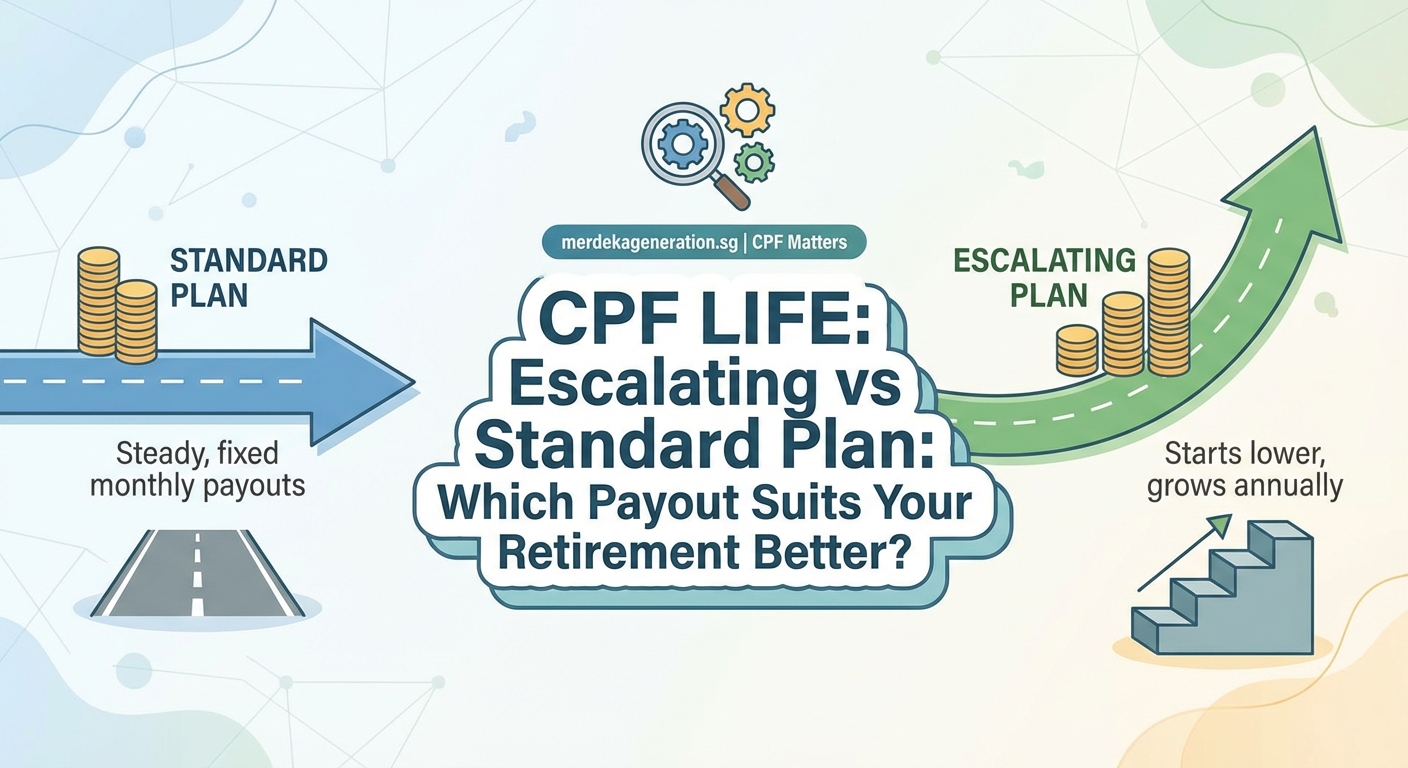
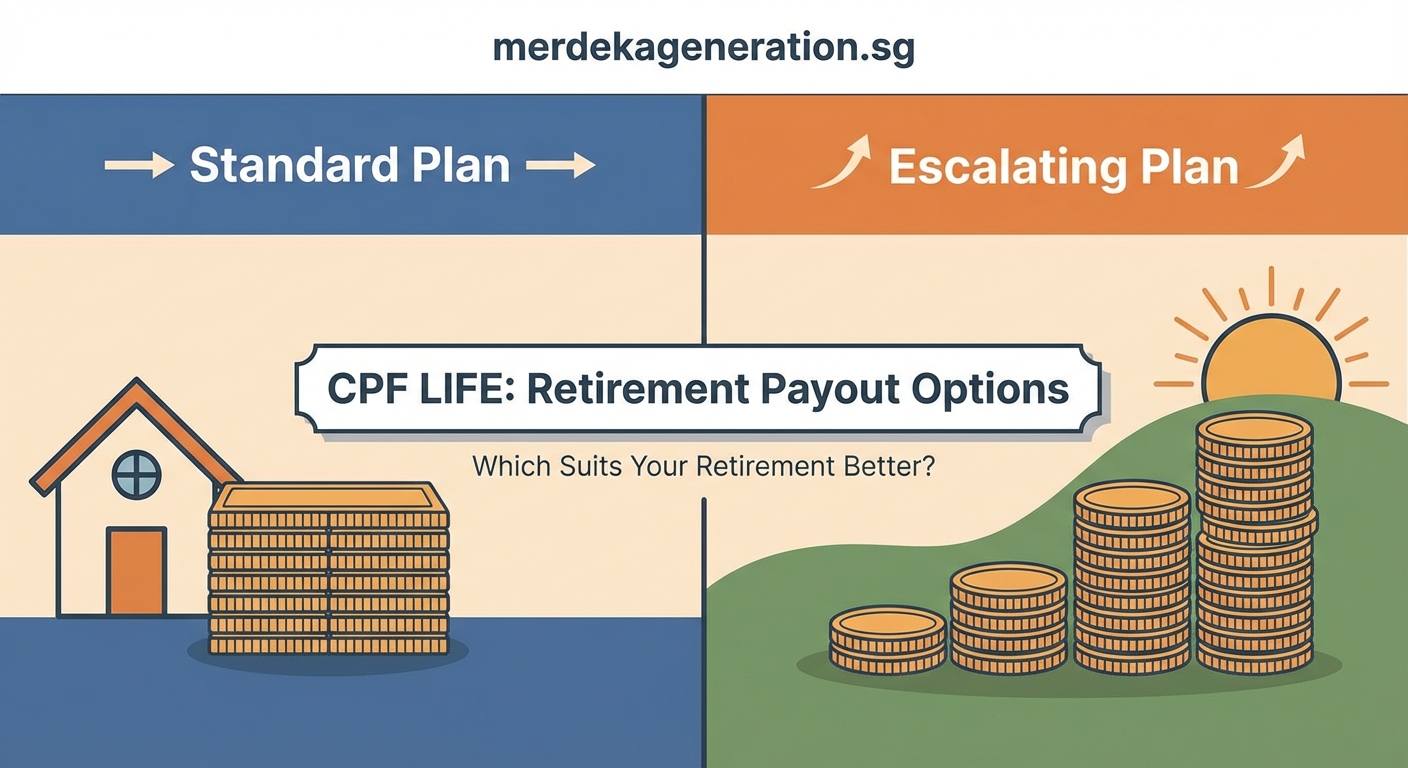
    CPF LIFE offers three plans, but most people choose between two: standard and escalating. The basic plan exists for those who want higher bequest amounts, but it provides significantly lower monthly payouts.

    The standard plan gives you the same payout amount every month for life. If you start receiving $1,500 monthly at age 65, you’ll still get $1,500 at age 85. Simple and predictable.

    The escalating plan starts with a lower monthly payout but increases by 2% each year. You might begin with $1,200 monthly, but by age 75, that grows to around $1,460. By age 85, it reaches approximately $1,780.

    Both plans guarantee lifelong payouts. You cannot outlive your CPF LIFE income, regardless of which plan you select.

    How the payout amounts actually compare

    CPF LIFE Escalating vs Standard Plan: Which Payout Suits Your Retirement Better? — 1

    Let’s use real numbers. Assume you have $200,000 in your Retirement Account at age 65.

    Standard Plan:
    – Monthly payout from age 65: approximately $1,500
    – Same amount at age 75: $1,500
    – Same amount at age 85: $1,500
    – Same amount at age 95: $1,500

    Escalating Plan:
    – Monthly payout from age 65: approximately $1,200
    – At age 75 (after 10 years of 2% increases): approximately $1,460
    – At age 85 (after 20 years): approximately $1,780
    – At age 95 (after 30 years): approximately $2,170

    The escalating plan catches up to the standard plan around age 82. Before that crossover point, you receive less each month. After that point, you receive more.

    Here’s what that means in total dollars:

    Age Range Standard Plan Total Escalating Plan Total Difference
    65 to 75 $180,000 $153,600 -$26,400
    75 to 85 $180,000 $194,400 +$14,400
    85 to 95 $180,000 $237,600 +$57,600

    The escalating plan only makes financial sense if you live past 82 and value higher payouts in your later years.

    When the standard plan makes more sense

    Most Singaporeans choose the standard plan. There are good reasons for this preference.

    You need stable income now. Retirement expenses don’t wait. Your HDB conservancy charges, utilities, groceries, and transport costs arrive every month. The standard plan gives you more money during your early retirement years when you’re most active.

    You have health concerns. If your family has a history of heart disease, diabetes, or other conditions that affect longevity, the standard plan delivers more total value. You maximize your monthly income during the years you’re most likely to enjoy it.

    You lack other income sources. Many retirees depend entirely on CPF LIFE. Without rental income, investment dividends, or part-time work, that extra $300 monthly from the standard plan matters. It covers an extra meal out each week or helps with unexpected medical bills.

    You want simpler budgeting. The same amount every month makes financial planning easier. You know exactly what you’ll receive and can plan accordingly. No calculations needed.

    The standard plan provides peace of mind for retirees who want predictable income without worrying about inflation adjustments or future projections. For most people, stability beats growth potential.

    When the escalating plan might work better

    CPF LIFE Escalating vs Standard Plan: Which Payout Suits Your Retirement Better? — 2

    The escalating plan suits specific situations. You need to honestly assess whether these apply to you.

    You have substantial savings outside CPF. If you’ve built up $300,000 in personal savings, investment portfolios, or property equity, you can afford lower initial payouts. The escalating plan becomes a hedge against inflation while your other assets cover immediate needs.

    You’re in excellent health with family longevity. If your parents lived past 90 and you maintain good health through exercise and diet, the escalating plan’s long-term benefits become more attractive. The 2% annual increase helps preserve purchasing power over 25 to 30 years.

    You plan to work part-time. Many retirees continue working in consulting, tutoring, or freelance roles. This supplementary income reduces dependence on CPF LIFE during early retirement. The escalating plan’s lower initial payout matters less when you’re still earning.

    Inflation genuinely worries you. Singapore’s inflation averaged around 2% to 3% annually over the past decade. The escalating plan’s 2% increase partially offsets this erosion. If you believe inflation will remain persistent, growing payouts protect your lifestyle.

    The inflation factor everyone talks about

    Inflation erodes purchasing power. That $1,500 monthly payout won’t buy the same amount of chicken rice, vegetables, or medication in 20 years.

    But here’s what people miss: inflation affects both plans equally until the crossover point. And Singapore’s actual inflation for retirees runs lower than headline figures suggest.

    Why? Because retiree spending patterns differ from working adults. You’re not buying property, paying for children’s education, or commuting daily. Healthcare costs rise, yes, but subsidies through programmes like the CHAS card benefits explained help offset increases.

    The escalating plan’s 2% increase matches moderate inflation. It doesn’t beat high inflation years. During periods of 4% inflation, both plans lose purchasing power. The escalating plan just loses slightly less after age 82.

    What happens to your savings when you pass away

    Both plans return unused premiums to your beneficiaries, but the amounts differ based on how long you live.

    CPF LIFE works like insurance. Part of your Retirement Account funds your monthly payouts. The rest forms a pool that pays members who live longer than average. This pooling mechanism enables lifelong payouts.

    If you pass away at age 70 after five years of payouts, your estate receives the remaining balance. The standard plan would have paid out more during those five years, leaving a smaller bequest. The escalating plan paid out less, leaving a larger bequest.

    If you live to 95, you’ve likely received more than your original Retirement Account balance under either plan. Your beneficiaries receive little or nothing, but you’ve enjoyed 30 years of guaranteed income. That’s the insurance working as designed.

    Steps to choose your CPF LIFE plan

    Making this decision requires honest self-assessment. Follow these steps:

    1. Calculate your total retirement funds. Add up your CPF balances, savings accounts, investments, and property equity. Know your complete financial picture.

    2. List your guaranteed monthly expenses. Write down conservancy charges, utilities, phone bills, insurance premiums, and regular medication costs. This is your baseline need.

    3. Assess your health and family history. Review your medical records and family longevity patterns. Be realistic, not optimistic.

    4. Identify supplementary income sources. Note any rental income, part-time work plans, children’s support, or investment dividends you expect.

    5. Compare the payout gap. Calculate how the $300 monthly difference (approximately) affects your early retirement lifestyle. Can you comfortably absorb this reduction?

    6. Project your age 82 financial situation. Will you likely still be active and spending at 82? Or will your expenses have naturally decreased?

    7. Make your selection before your 65th birthday. CPF automatically enrolls you in the standard plan if you don’t choose. You can change plans once before payouts begin.

    Common mistakes when choosing between plans

    People make predictable errors during this decision. Avoid these traps:

    • Overestimating longevity. Everyone thinks they’ll live to 95. Statistics say otherwise. Half of Singaporeans don’t reach 85. Choose based on realistic expectations, not wishful thinking.

    • Ignoring present needs for future gains. The escalating plan sounds smart on paper. But struggling financially at 68 because you chose lower payouts feels terrible. Don’t sacrifice your 60s and 70s for theoretical benefits in your 90s.

    • Forgetting about other inflation hedges. If you own property, its value generally rises with inflation. If you have CPF balances earning interest, those grow too. The escalating plan isn’t your only inflation protection.

    • Choosing based on others’ advice. Your brother’s financial situation differs from yours. Your colleague’s health isn’t your health. Make this decision based on your specific circumstances, not general recommendations.

    For those navigating broader retirement planning questions, understanding how much money Merdeka Generation seniors really need for retirement in Singapore provides helpful context beyond just CPF LIFE payouts.

    The break-even analysis you should understand

    Financial advisors love break-even calculations. Here’s the simple version:

    Under the standard plan, you receive approximately $300 more monthly for the first 17 years (ages 65 to 82). That’s $61,200 in extra payouts.

    After age 82, the escalating plan pays more. The monthly advantage grows each year as the 2% increases compound. By age 90, you’re receiving about $500 more monthly than the standard plan.

    To recover that initial $61,200 disadvantage takes roughly 10 years of higher payouts. So you need to live to approximately 92 for the escalating plan to deliver more total lifetime income.

    Ask yourself: do you confidently expect to live past 92? If yes, escalating makes mathematical sense. If you’re unsure, standard provides more certain value.

    Additional factors worth considering

    Cognitive decline matters. Managing finances becomes harder as you age. The standard plan’s simplicity helps. You don’t need to track annual increases or adjust budgets. The same amount arrives monthly.

    Spouse coordination counts. If both you and your spouse have CPF LIFE, consider choosing different plans. One person takes standard for immediate stability. The other takes escalating for long-term inflation protection. This diversification balances both concerns.

    Top-up opportunities exist. You can increase your Retirement Account balance through voluntary contributions or transfers from Special Account balances. Larger balances mean higher payouts under either plan. Some retirees find that topping up CPF LIFE after 65 provides better returns than the escalating plan’s structure.

    Plan changes have deadlines. You can switch between plans, but only before your payout start date. Once monthly payouts begin, your choice becomes permanent. Don’t rush, but don’t delay past your 65th birthday without making an active decision.

    What the numbers don’t tell you

    Spreadsheets can’t capture everything. Some considerations resist quantification.

    Peace of mind has value. Knowing you’ll receive $1,500 monthly forever brings comfort. You can plan vacations, help grandchildren, or donate to causes you care about without worrying about future payout changes.

    Flexibility matters differently at different ages. At 68, an extra $300 monthly might fund weekly restaurant meals with friends. At 88, you might spend less on dining out but more on home care. The escalating plan’s higher late-life payouts could fund better care options.

    Your retirement vision shapes the right choice. If you plan active early retirement with travel and hobbies, the standard plan’s higher initial payouts enable that lifestyle. If you expect to slow down early but worry about care costs later, escalating provides growing resources when you might need them most.

    Making peace with your decision

    No perfect answer exists. Both plans have merits. Both have limitations.

    The standard plan serves most retirees well. It provides maximum income during your healthiest, most active retirement years. It simplifies budgeting. It delivers certain value without requiring you to live into your 90s.

    The escalating plan suits those with financial cushions and strong health. It offers inflation protection and higher late-life payouts. But it requires patience and the ability to manage on less during early retirement.

    Choose based on your specific situation. Consider your health, savings, other income, and honest longevity expectations. Don’t let fear of inflation push you toward escalating if you genuinely need higher income now.

    Remember that CPF LIFE represents just one part of retirement planning. Healthcare subsidies, housing equity, family support, and lifestyle choices all contribute to retirement security. Making the wrong CPF LIFE choice won’t ruin your retirement, and making the right choice won’t guarantee comfort without broader planning.

    Your retirement income deserves careful thought

    This decision affects decades of your life. Take time to review your complete financial picture. Calculate your actual monthly needs. Assess your health honestly. Consider your family’s history.

    Talk with your spouse if you’re married. Discuss with adult children if they’re involved in your financial planning. But ultimately, choose the plan that helps you sleep soundly, knowing your basic needs stay covered throughout retirement, regardless of how long you live.

  • CPF Medisave for Seniors: How Much You Need and How to Use It Wisely

    Planning for healthcare costs after 55 can feel overwhelming. Your MediSave account sits there quietly, but do you really know how much you need and when to use it? Many seniors worry they’ll run out of funds for medical bills, or worse, that they’re not using their savings wisely. The good news is that understanding CPF MediSave for seniors doesn’t require a finance degree. It just needs clear information and practical steps.

    Key Takeaway

    MediSave helps Singaporean seniors pay for approved medical treatments, insurance premiums, and chronic disease management. The Basic Healthcare Sum (BHS) for 2024 is $71,500, but your actual needs depend on your health condition, insurance coverage, and family medical history. Smart usage means balancing current healthcare needs with future reserves while maximising Merdeka Generation benefits.

    What is MediSave and how does it work for seniors

    MediSave is your personal healthcare savings account within CPF. It earns interest (currently 4% per year) and can only be used for approved medical expenses.

    Once you turn 55, your MediSave works differently. You stop making contributions from salary, but the account continues earning interest. The money stays locked for healthcare purposes, which protects you from accidentally spending it on non-medical items.

    Here’s what changes after 55:

    • No more monthly contributions unless you’re still working
    • Interest continues to compound on your balance
    • You can use it for more types of medical expenses
    • The Basic Healthcare Sum becomes your target amount
    • Excess above BHS can be withdrawn or transferred

    The Basic Healthcare Sum for 2024 is $71,500. This amount adjusts yearly to account for healthcare inflation. Think of it as the government’s estimate of what you’ll need for basic medical coverage throughout retirement.

    How much MediSave do you actually need

    The BHS is a guideline, not a magic number. Your real needs depend on several factors.

    Your current health status matters most. Someone managing diabetes and high blood pressure will use MediSave faster than someone in excellent health. Chronic conditions require regular medication, specialist visits, and monitoring tests.

    Family medical history gives clues. If your parents had heart disease or cancer, you might need more reserves. These conditions often require expensive treatments and longer hospital stays.

    Your insurance coverage changes the equation. MediShield Life covers basic hospitalisation, but how to maximise your MediShield Life coverage as a Merdeka Generation senior can significantly reduce your out-of-pocket costs. Integrated Shield Plans provide better coverage but cost more in premiums.

    Here’s a practical calculation method:

    1. Check your current MediSave balance on the CPF website
    2. List your regular medical expenses (medications, specialist visits, physiotherapy)
    3. Estimate annual costs based on past bills
    4. Add a buffer of 20% for unexpected health issues
    5. Calculate how many years your balance will last

    Most seniors with chronic conditions use between $2,000 to $5,000 from MediSave yearly. Healthy seniors might use less than $1,000. A major surgery or hospitalisation can cost $10,000 to $30,000 even after insurance.

    What you can pay for with MediSave

    MediSave covers more than most people realise. Knowing all your options helps you use it strategically.

    Hospitalisation and surgery are the biggest expenses. MediSave pays for approved ward charges, surgeon fees, and operating theatre costs at public and private hospitals. The withdrawal limits depend on the procedure type.

    Outpatient treatments include selected services:

    • Chronic disease management (diabetes, high blood pressure, stroke, asthma)
    • Day surgery procedures
    • Cancer treatments including chemotherapy and radiotherapy
    • Kidney dialysis
    • MRI and CT scans with doctor referral

    Insurance premiums can be paid using MediSave. This includes MediShield Life, Integrated Shield Plans, and CareShield Life. Paying premiums through MediSave preserves your cash for daily living expenses.

    Vaccinations approved by the Ministry of Health are claimable. This includes flu shots and pneumonia vaccines recommended for seniors.

    Long-term care costs are partially covered. Nursing home fees and home medical services have MediSave withdrawal limits, but every bit helps reduce cash outlay.

    The CHAS card benefits explained for Merdeka Generation seniors work alongside MediSave to reduce your medical bills further. CHAS subsidises GP visits and dental care, while MediSave handles bigger expenses.

    Common MediSave mistakes that cost seniors money

    Many seniors make avoidable errors that drain their accounts faster or leave benefits unclaimed.

    Mistake Why It Hurts Better Approach
    Not checking withdrawal limits You pay cash when MediSave could cover it Review CPF withdrawal limits before treatment
    Ignoring Merdeka Generation top-ups Missing free $200 annually Ensure your annual MG card top-up is credited
    Paying premiums in cash Wasting MediSave that earns interest Use MediSave for all eligible insurance premiums
    Not using MediSave for approved outpatient care Spending cash unnecessarily Check if your treatment qualifies before paying
    Withdrawing excess too early Losing compound interest benefits Keep funds in MediSave unless you need cash urgently

    The 5 common mistakes Merdeka Generation seniors make when claiming benefits often overlap with MediSave errors. Many seniors simply don’t know what they’re entitled to use.

    “I paid $800 cash for my diabetes medication last year before my daughter told me I could use MediSave. I thought it was only for hospital stays. That was money I could have saved.” – Mrs Tan, 68, Ang Mo Kio

    How to check and manage your MediSave balance

    Staying on top of your balance prevents surprises when you need medical care.

    Online through Singpass:

    1. Log in to the CPF website using Singpass
    2. Navigate to “My Statement” under the dashboard
    3. View your MediSave account balance and transaction history
    4. Download statements for record keeping
    5. Set up email alerts for large withdrawals

    At CPF Service Centres if you prefer face-to-face help. Bring your NRIC and they’ll print your statement on the spot. The staff can explain transactions you don’t understand.

    Through the CPF mobile app for checking on the go. The app shows real-time balances and recent transactions. It’s particularly useful when you’re at the hospital and need to verify available funds.

    Check your balance at least quarterly. This habit helps you spot unauthorised withdrawals (rare but possible) and plan for upcoming medical expenses.

    Strategic ways to use MediSave wisely

    Smart usage means getting maximum value while preserving funds for later years.

    Pay insurance premiums first. This is non-negotiable. MediShield Life and Integrated Shield Plan premiums protect you from catastrophic medical bills. The premiums increase as you age, so using MediSave preserves your cash.

    Prioritise chronic disease management. Regular medication and monitoring prevent expensive complications. Paying $100 monthly for diabetes control beats paying $20,000 for dialysis later.

    Use it for preventive care when eligible. Vaccinations and health screenings catch problems early. Early detection of cancer or heart disease dramatically improves outcomes and reduces treatment costs.

    Coordinate with family members. You can use your MediSave to pay for your spouse, parents, grandparents, or children’s medical expenses. This flexibility helps families manage healthcare costs together.

    Time elective procedures strategically. If you need a knee replacement or cataract surgery, schedule it when your MediSave balance is healthy. Don’t wait until you’ve depleted the account on other expenses.

    Keep some cash reserves anyway. MediSave has withdrawal limits. A serious illness might require cash top-ups beyond what MediSave covers. How much money do Merdeka Generation seniors really need for retirement includes healthcare budgeting beyond MediSave.

    Special considerations for Merdeka Generation members

    If you were born between 1950 and 1959, you enjoy additional benefits that work with your MediSave.

    The Merdeka Generation Package provides extra subsidies that reduce how much MediSave you need to use. Your outpatient subsidies at polyclinics and CHAS GP clinics are higher, meaning each visit costs less.

    You receive $200 in MediSave top-ups annually. This might not sound like much, but over ten years, it’s $2,000 plus interest. Make sure you’ve checked if you qualify for the Merdeka Generation package and that your benefits are active.

    Your MediShield Life premiums receive additional subsidies. The government pays part of your premium, which means your MediSave balance lasts longer.

    If you’re planning to spend extended time overseas, understand whether you’ll lose your Merdeka Generation benefits when moving overseas after retirement. Your MediSave stays yours, but some subsidies require you to be in Singapore.

    What happens when your MediSave exceeds the BHS

    Having more than the Basic Healthcare Sum isn’t necessarily better. The excess can be withdrawn or used differently.

    Once you reach 65, any amount above the BHS can be withdrawn as cash. You can also transfer it to your Retirement Account to boost your CPF LIFE payouts. The decision depends on your financial situation.

    Withdraw if you need cash flow. Retirees with limited savings might prefer accessing the excess for daily expenses. The money is yours and you’ve already met the healthcare reserve target.

    Transfer to boost CPF LIFE if you have sufficient cash savings. Should you top up your CPF LIFE after 65 explains the trade-offs. Higher CPF LIFE balances mean larger monthly payouts for life.

    Leave it in MediSave if you anticipate major medical expenses. Some seniors prefer the security of having extra reserves, especially if they have serious health conditions or family history of expensive illnesses.

    The interest rate on MediSave (4%) is competitive with many savings accounts. Keeping funds there isn’t wasteful if you don’t need immediate cash access.

    When MediSave isn’t enough and what to do

    Even with careful planning, serious illnesses can exceed your MediSave capacity.

    MediShield Life kicks in for large hospital bills. It covers up to 100% of bills at public hospital B2/C wards after deductibles and co-payment. Private hospital bills or higher ward classes have lower coverage.

    Government subsidies reduce the gap. Public hospitals offer subsidies based on income. Lower-income seniors can receive 75% to 80% subsidies on bills.

    MediFund is the safety net. If you truly cannot afford medical bills after insurance and subsidies, MediFund provides financial assistance. Apply through the hospital’s medical social worker.

    Family support often bridges shortfalls. Adult children can use their own MediSave to pay for parents’ medical expenses. This inter-generational support is built into the CPF system.

    If your healthcare subsidy claim gets rejected, don’t panic. There’s usually an appeal process, and medical social workers can help navigate it.

    Topping up your MediSave account voluntarily

    You can add money to MediSave beyond mandatory contributions. This makes sense in specific situations.

    Tax relief is the main incentive. Voluntary contributions to your own or family members’ MediSave accounts qualify for tax relief up to certain limits. For higher-income earners still working past 55, this reduces tax bills while building healthcare reserves.

    Helping elderly parents is another common reason. If your parents’ MediSave is running low and they face ongoing medical expenses, topping up their account helps them maintain independence.

    Pre-funding known medical procedures gives peace of mind. If you’re scheduled for surgery next year, topping up now means the funds are ready and earning interest.

    The process is simple. Log in to CPF website, select voluntary contribution, and transfer funds via internet banking. The money is credited within days.

    Understanding withdrawal limits and restrictions

    MediSave isn’t unlimited. Each type of medical expense has specific withdrawal limits.

    Hospitalisation limits depend on the procedure. Common surgeries have fixed withdrawal limits ranging from a few hundred to several thousand dollars. Complex procedures allow higher withdrawals.

    Outpatient limits are lower. Chronic disease management has annual caps per condition. You can’t withdraw unlimited amounts even if your balance is high.

    Insurance premium limits are set by the government. MediShield Life premiums have age-based limits. Integrated Shield Plan premiums have additional withdrawal caps.

    These limits exist to preserve your MediSave for long-term needs. They prevent you from depleting the account too early in retirement.

    Check the CPF website for current withdrawal limits before scheduling medical procedures. Knowing the limits helps you budget for any cash top-up needed.

    Coordinating MediSave with other retirement funds

    MediSave is one piece of your retirement financial puzzle. It works best when coordinated with other accounts.

    Your CPF Ordinary Account and Special Account merge into the Retirement Account at 55. These fund your CPF LIFE monthly payouts. Can you withdraw your CPF savings at 65 explains the withdrawal rules for different accounts.

    Cash savings should cover expenses that MediSave doesn’t. This includes over-the-counter medications, health supplements, and medical equipment not approved for MediSave withdrawal.

    Investment portfolios might provide additional healthcare funding. Some retirees keep a portion of investments specifically for major medical expenses, preserving MediSave for routine care.

    Private insurance (Integrated Shield Plans, cancer insurance, critical illness coverage) reduces reliance on MediSave. Higher premiums mean better coverage and less out-of-pocket costs during treatment.

    Planning for different health scenarios

    Your MediSave strategy should account for various health outcomes.

    Best case scenario: You stay healthy into your 80s. MediSave covers routine checkups, vaccinations, and minor ailments. Your balance grows from interest and you might withdraw excess after 65.

    Moderate scenario: You develop one or two chronic conditions. MediSave pays for regular medications and specialist visits. Your balance slowly decreases but lasts throughout retirement with careful management.

    Serious illness scenario: You face cancer, heart disease, or stroke. Hospital bills are high but MediShield Life covers most costs. MediSave pays deductibles and co-payments. You might need to tap family support or government assistance for gaps.

    Long-term care scenario: You need nursing home care or home medical services. MediSave helps but doesn’t cover full costs. CareShield Life provides monthly payouts. Family support becomes crucial.

    Planning for each scenario means having backup options. Don’t rely solely on MediSave. Build multiple layers of healthcare financing.

    Your MediSave works harder when you understand it

    MediSave isn’t just a number on your CPF statement. It’s your healthcare safety net that deserves attention and strategy.

    Check your balance regularly. Know what you can claim. Use it for approved expenses instead of paying cash. Coordinate with your Merdeka Generation benefits to stretch every dollar further. And remember, the goal isn’t to die with the highest MediSave balance. It’s to maintain your health and dignity throughout retirement without financial stress.

    Your healthcare needs will change as you age. Review your MediSave strategy annually, especially after major health events or changes in family circumstances. The effort you put into understanding CPF MediSave for seniors today pays dividends in peace of mind tomorrow.

  • Can You Withdraw Your CPF Savings at 65? Everything You Need to Know

    Turning 65 marks a major milestone in your CPF journey. You’ve spent decades building up your retirement savings, and now you’re wondering how much you can actually take out. The answer isn’t always straightforward, but understanding your options helps you make better decisions for your retirement years.

    Key Takeaway

    At 65, you can withdraw CPF savings above your Full Retirement Sum if you meet it, or all savings beyond what’s set aside for monthly CPF LIFE payouts. Most members receive monthly payouts instead of full withdrawals. The amount you can access depends on your Retirement Account balance, property pledge status, and chosen CPF LIFE plan. Understanding these rules helps you plan retirement income effectively.

    What happens to your CPF when you turn 65

    Your 65th birthday triggers automatic changes to your CPF accounts. The Retirement Account becomes your primary focus, and CPF LIFE payouts typically begin.

    Most members start receiving monthly payouts automatically. The CPF Board calculates your payout amount based on your Retirement Account balance and the plan you’re on.

    If you haven’t chosen a CPF LIFE plan, you’ll be placed on the Standard Plan by default. This gives you steady monthly income for life, but it also means you can’t withdraw everything at once.

    Your Ordinary Account and Special Account balances get transferred to your Retirement Account at 55. By 65, these accounts may hold small amounts from ongoing contributions if you’re still working.

    How much can you actually withdraw at 65

    The withdrawal amount depends entirely on whether you’ve met your Full Retirement Sum.

    If you meet your Full Retirement Sum:

    You can withdraw everything above this amount as a lump sum. The Full Retirement Sum changes yearly. For 2024, it sits at $198,800.

    Let’s say you have $220,000 in your Retirement Account. You can withdraw $21,200 immediately. The remaining $198,800 stays locked for your monthly payouts.

    If you haven’t met your Full Retirement Sum:

    You cannot make any withdrawal from your Retirement Account. All your savings go towards funding your CPF LIFE payouts.

    This applies to many Singaporeans who used their CPF for housing or had lower contribution rates throughout their careers.

    If you pledged your property:

    You might have a lower retirement sum requirement. The Basic Retirement Sum for 2024 is $99,400. If you meet this through property pledge, you can withdraw amounts above the Basic Retirement Sum.

    Property pledge means your flat or home serves as part of your retirement provision. When you eventually sell the property, proceeds go back to your Retirement Account.

    The step by step process to withdraw CPF at 65

    Making a withdrawal requires following specific procedures. Here’s how to do it properly.

    1. Log in to your CPF account through Singpass on the CPF website
    2. Navigate to the retirement withdrawal section under “My Request”
    3. Check your withdrawal eligibility and available amount
    4. Select the amount you want to withdraw (up to your eligible limit)
    5. Choose your payout method (bank transfer to your registered account)
    6. Confirm your withdrawal request and note the reference number
    7. Wait for processing, which typically takes 5 to 7 working days

    The money goes directly to your registered bank account. Make sure your bank details are updated before submitting your request.

    You can also visit a CPF Service Centre to make the withdrawal in person. Bring your NRIC and be prepared to fill out forms. Staff can help if you face any technical difficulties with the online system.

    “Many seniors don’t realise they can only withdraw excess savings above their retirement sum. Planning ahead at 55 gives you more flexibility to manage your CPF balances before they get locked in at 65.” – CPF Advisory Panel

    Understanding CPF LIFE and why it affects withdrawals

    CPF LIFE stands for CPF Lifelong Income For the Elderly. It’s an annuity scheme that provides monthly payouts for as long as you live.

    Once you join CPF LIFE, your Retirement Account savings get converted into monthly income. This is why you can’t withdraw everything at 65.

    The government designed this system to prevent retirees from spending all their savings too quickly. Monthly payouts ensure you have steady income throughout retirement.

    Three CPF LIFE plans exist:

    • Standard Plan: Balanced monthly payouts with a moderate bequest for your beneficiaries
    • Escalating Plan: Lower starting payouts that increase over time to match inflation
    • Basic Plan: Higher monthly payouts with minimal bequest

    Your plan choice affects how much stays in your Retirement Account. The Basic Plan typically gives higher monthly amounts but leaves less for your loved ones.

    If you’re part of the Merdeka Generation, understanding how these plans work alongside your healthcare benefits becomes even more important for comprehensive retirement planning.

    Common withdrawal scenarios explained

    Let’s look at real situations to clarify how withdrawals work.

    Scenario 1: Uncle Tan has $250,000 in his Retirement Account

    He meets the Full Retirement Sum of $198,800. He can withdraw $51,200 immediately. His monthly CPF LIFE payout gets calculated based on the remaining $198,800.

    Scenario 2: Auntie Lim has $120,000 and pledged her HDB flat

    She meets the Basic Retirement Sum of $99,400 through property pledge. She can withdraw $20,600. Her monthly payouts come from the $99,400 set aside.

    Scenario 3: Mr Raj has $80,000 in his Retirement Account

    He doesn’t meet any retirement sum. He cannot make any withdrawal. All $80,000 funds his CPF LIFE payouts, though his monthly amount will be lower than someone with a fuller account.

    Scenario 4: Mdm Wong wants to withdraw at 65 but delays her payouts

    She can defer her CPF LIFE payouts up to age 70. During this deferral period, she cannot withdraw her Retirement Account savings. The money stays invested, earning interest, and her future monthly payouts will be higher.

    What you need to know about the Retirement Sum Scheme vs CPF LIFE

    Older members might be on the Retirement Sum Scheme instead of CPF LIFE. This affects withdrawal rules differently.

    The Retirement Sum Scheme applies to Singaporeans who turned 55 before 2009. Instead of lifelong payouts, you receive monthly income for about 20 years, calculated to last until around age 85 to 90.

    After your Retirement Sum Scheme payouts end, you can withdraw any remaining balance. This differs from CPF LIFE, which continues paying until you pass away.

    If you’re on the Retirement Sum Scheme, check your payout duration. Some members exhaust their Retirement Account before age 85, leaving them without CPF income in their later years.

    Mistakes to avoid when planning your withdrawal

    Many retirees make preventable errors that affect their financial security.

    Common Mistake Why It Hurts Better Approach
    Withdrawing maximum amount immediately Reduces monthly payout potential and leaves less buffer for emergencies Keep excess savings in CPF to earn higher interest rates
    Not checking property pledge status May think you can withdraw more than you actually can Verify your retirement sum type before turning 65
    Forgetting about Medisave requirements Medisave stays locked regardless of Retirement Account withdrawals Plan healthcare costs separately from retirement income
    Assuming all CPF is accessible Only amounts above retirement sums can be withdrawn Review your CPF statement months before turning 65
    Missing the deadline to choose CPF LIFE plan Gets placed on Standard Plan automatically Select your preferred plan before your 65th birthday

    The common mistakes that Merdeka Generation seniors make often extend to CPF withdrawals too. Being aware helps you avoid costly errors.

    Your Medisave Account at 65 and beyond

    While we’re focused on retirement savings, your Medisave Account operates under different rules.

    At 65, you must maintain the Basic Healthcare Sum in your Medisave Account. For 2024, this amount is $68,500. Any Medisave savings above this sum can be withdrawn.

    These withdrawals are separate from your Retirement Account withdrawals. You can access excess Medisave even if you haven’t met your Full Retirement Sum.

    Many seniors use excess Medisave to pay MediShield Life premiums or help family members with medical expenses. The funds can also go towards approved medical insurance or treatments.

    Your Medisave continues earning interest at higher rates than regular savings accounts. Leaving money in Medisave makes sense if you don’t need it immediately.

    How ongoing work affects your CPF at 65

    Still working at 65? Your employment status changes how CPF contributions work.

    Employers contribute to your retirement accounts at reduced rates after you turn 55. These contributions go to your Ordinary Account, Special Account, and Medisave Account based on allocation rates.

    Any new contributions to your Ordinary Account after 65 can be withdrawn immediately. They don’t get locked into your Retirement Account since that transfer only happens once at 55.

    This means working past 65 gives you more accessible cash through CPF. Your monthly salary contributions become available for withdrawal almost right away.

    Some seniors continue working specifically for this reason. The CPF contributions supplement their CPF LIFE payouts and provide extra flexibility.

    Planning your retirement income strategy

    Withdrawing CPF at 65 should fit into a broader retirement plan. Think about your total income sources.

    Your income might include:

    • Monthly CPF LIFE payouts
    • Lump sum withdrawal from excess retirement savings
    • Rental income from property
    • Part-time work or consultancy
    • Investment returns
    • Family support

    Calculate your monthly expenses realistically. Include healthcare costs, utilities, food, transport, and some buffer for unexpected needs.

    Compare your expected income against these expenses. If there’s a shortfall, consider whether withdrawing your excess CPF helps or whether keeping it invested makes more sense.

    The CPF Retirement Account earns up to 6% interest on the first $30,000 and up to 5% on the next $30,000. This beats most savings accounts and many conservative investments.

    For Merdeka Generation members, factoring in your annual MediSave top-up and other benefits provides a clearer picture of your actual retirement resources.

    What happens if you need more money urgently

    Sometimes life throws unexpected expenses your way. Medical emergencies, home repairs, or family needs might require more cash than your monthly payouts provide.

    If you’ve already withdrawn your excess CPF, you’ll need to look at other options:

    • Apply for government assistance schemes like ComCare
    • Use your Medisave for approved medical expenses
    • Consider a temporary loan from family members
    • Look into Silver Housing Bonus if you downsize your flat
    • Monetise your home through the Lease Buyback Scheme

    The Lease Buyback Scheme lets you sell part of your flat lease back to HDB. This tops up your Retirement Account, increasing your monthly payouts. It’s worth considering if you own an HDB flat and need more retirement income.

    Adjusting your CPF LIFE plan after 65

    You might regret your initial CPF LIFE plan choice. The good news is you can switch plans, but only once.

    You can change from the Standard Plan to the Escalating Plan or Basic Plan within a limited window. Contact CPF to understand your switching options based on when you started your payouts.

    Switching plans affects your monthly payout amount and the bequest your beneficiaries receive. Run the numbers carefully before making changes.

    The comparison between CPF LIFE plans helps you understand which option suits your situation better. Some seniors prefer higher immediate income, while others want payouts that keep pace with inflation.

    Special considerations for Merdeka Generation members

    If you’re part of the Merdeka Generation, born between 1950 and 1959, you have additional support beyond CPF.

    Your Merdeka Generation Package provides healthcare subsidies and MediSave top-ups. These benefits work alongside your CPF withdrawals and monthly payouts.

    The annual $200 MediSave top-up doesn’t affect your Retirement Account withdrawals. It goes directly to your Medisave Account for healthcare expenses.

    When planning your retirement finances, include these additional benefits in your calculations. They reduce your out-of-pocket healthcare costs significantly.

    If you’re unsure about your eligibility status, you can check if you qualify for the Merdeka Generation Package through official channels.

    Tax implications of CPF withdrawals

    CPF withdrawals at 65 are not taxable income in Singapore. You don’t need to declare them when filing your taxes.

    This applies to both lump sum withdrawals and monthly CPF LIFE payouts. The money has already been taxed when you earned it during your working years.

    However, if you invest your withdrawn CPF funds and earn returns, those investment gains might have tax implications depending on the investment type.

    Interest earned while your money sits in CPF accounts is also tax-free. This makes CPF an attractive place to keep retirement savings from a tax perspective.

    How property ownership affects your options

    Owning property changes your CPF withdrawal landscape significantly. Many Singaporeans used CPF for housing, which affects their Retirement Account balances.

    If you pledged your property to meet the Basic Retirement Sum, you have more flexibility. You can withdraw amounts above the Basic Retirement Sum instead of needing to meet the Full Retirement Sum.

    Selling your property later in retirement triggers CPF refunds. The proceeds must first refund what you withdrew for housing, plus accrued interest. Only after satisfying this refund can you keep the remaining cash.

    Some retirees downsize specifically to unlock CPF-related property value. Moving from a larger flat to a smaller one can free up cash while still maintaining the property pledge benefit.

    Making your withdrawal decision work for you

    Your CPF withdrawal choice at 65 shapes your retirement for years to come. Take time to think through your needs.

    Consider your health status. If you have medical conditions requiring ongoing treatment, keeping more in Medisave and maintaining higher CPF LIFE payouts might serve you better than a large withdrawal.

    Think about your family situation. Do you have dependents who rely on you financially? Will you need to help children or grandchildren with major expenses?

    Evaluate your risk tolerance. Money withdrawn from CPF and invested elsewhere carries market risk. CPF accounts offer guaranteed returns without market volatility.

    The right choice varies for everyone. A 65-year-old still working part-time has different needs than someone with health issues who stopped working years ago.

    For those helping elderly parents navigate these decisions, knowing how to help your parents claim all their benefits makes the process smoother for everyone involved.

    Getting help with your CPF decisions

    Don’t hesitate to seek guidance when making major financial decisions about your retirement savings.

    The CPF Board offers free advisory services. You can book appointments at service centres or call their hotline for specific questions about your account.

    Financial advisers can help you see the bigger picture, though make sure they’re qualified and registered with the Monetary Authority of Singapore.

    Community centres and senior activity centres sometimes run CPF education workshops. These sessions explain withdrawal rules in simple terms and let you ask questions in a comfortable setting.

    Family members can also attend CPF appointments with you. Having another set of ears helps you remember important details and make better decisions.

    Your retirement security starts with informed choices

    Understanding how to withdraw CPF at 65 gives you control over your retirement finances. The rules might seem complex at first, but they exist to protect your long-term security.

    Your withdrawal options depend on your retirement sum status, property situation, and CPF LIFE plan. Take time to review your CPF statement, understand your balances, and plan ahead before your 65th birthday arrives.

    Whether you can withdraw a substantial amount or nothing at all, knowing your situation helps you prepare. You can adjust other aspects of your retirement plan to compensate for limited CPF access or make smart decisions about excess savings.

    Your CPF journey doesn’t end at 65. It transforms into a reliable income source that supports you through your retirement years. Making informed decisions now sets you up for financial peace of mind in the decades ahead.

  • Should You Top Up Your CPF LIFE After 65? A Practical Guide for Merdeka Generation

    Should You Top Up Your CPF LIFE After 65? A Practical Guide for Merdeka Generation

    You’ve turned 65, started receiving your CPF LIFE payouts, and now you’re wondering if it still makes sense to add more money into the system. It’s a fair question. After all, the rules around topping up your Retirement Account change once you hit this milestone, and not everyone explains what happens next.

    Key Takeaway

    You can still top up your CPF LIFE after 65, and it will increase your monthly payouts. However, you lose access to tax relief on these contributions, and the payout increase takes effect only from the following month. Merdeka Generation seniors should weigh this against other uses for their cash, especially if healthcare or family needs are pressing. Topping up makes most sense if you have spare funds and want guaranteed lifelong income.

    Can you still top up CPF LIFE once you’ve started receiving payouts?

    Yes, you can.

    Many people assume that once CPF LIFE payouts begin at 65, the door closes on voluntary contributions. That’s not true. You can continue making cash top-ups to your Retirement Account even after payouts have started.

    The CPF Board will recalculate your monthly payout based on the new balance. The adjustment happens from the month after your top-up is credited. So if you top up in March, your April payout will reflect the increase.

    But there’s a catch. You won’t enjoy tax relief anymore. The government allows tax relief only for top-ups made before you turn 65 or before your payouts start, whichever comes first. Once you’re past that line, every dollar you add is purely for boosting your monthly income, not for reducing your tax bill.

    For Merdeka Generation members who are already receiving healthcare subsidies and the annual $200 top-up, this might feel like a trade-off worth considering. If you qualify for the Merdeka Generation Package, you’re already getting some financial cushioning. The question is whether adding more to CPF LIFE is the best use of your spare cash.

    How much will your payout increase if you top up after 65?

    Should You Top Up Your CPF LIFE After 65? A Practical Guide for Merdeka Generation — image 1

    The increase depends on how much you add and which CPF LIFE plan you’re on.

    CPF uses an actuarial formula to convert your top-up into additional monthly income. The exact amount varies based on your age, gender, and the plan you selected when you turned 65. Generally, the older you are when you top up, the higher the monthly increase per dollar added, because the payout period is shorter.

    Here’s a simplified example. If you’re 66 and you top up $10,000, you might see your monthly payout rise by around $50 to $70. If you’re 70 and you top up the same amount, the increase could be closer to $80 to $100. These are rough estimates. The CPF website provides calculators, but they don’t always account for post-65 top-ups clearly. You may need to call the CPF hotline for a precise figure.

    One thing to note is that the payout increase is permanent. Once it’s recalculated, you’ll receive that higher amount every month for the rest of your life. If you live another 20 years, that $10,000 top-up could translate into tens of thousands of dollars in total payouts.

    But if you need that $10,000 for medical bills, home repairs, or helping your children, the calculation changes. CPF LIFE is not liquid. Once the money goes in, you can’t pull it out except through monthly payouts.

    What are the practical steps to top up your Retirement Account after 65?

    Topping up is straightforward. Here’s how you do it.

    1. Log in to the CPF website using your Singpass.
    2. Navigate to the “My Request” section and select “Apply for Top-Up”.
    3. Choose “Retirement Account” as the destination.
    4. Enter the amount you want to top up and confirm the transaction.
    5. Make payment via PayNow, eNETS, or GIRO.

    The money is usually credited within one to two working days. Your new payout amount will take effect from the following month.

    If you’re not comfortable with online banking, you can also visit a CPF Service Centre and make the top-up in person. Bring your NRIC and the cash or cheque you want to contribute.

    One common mistake is topping up too close to the end of the month. If your contribution is credited after the payout for that month has been processed, you’ll have to wait another month to see the increase. Plan ahead if you want the adjustment to kick in sooner.

    Also, remember that there’s no maximum limit for cash top-ups to your own Retirement Account after 65. However, if you’re topping up for someone else, like a spouse or parent, the annual limit is $8,000 per recipient.

    Should you top up if you’re also receiving Merdeka Generation benefits?

    Should You Top Up Your CPF LIFE After 65? A Practical Guide for Merdeka Generation — image 2

    This is where your personal situation matters most.

    Merdeka Generation members already enjoy subsidies on outpatient care, MediShield Life premiums, and the annual $200 PAssist top-up. If your healthcare costs are well covered and you have surplus income, topping up CPF LIFE can be a safe way to lock in more retirement income.

    But if you’re relying on those subsidies because money is tight, adding more to CPF LIFE might not be the best move. You can’t use CPF LIFE payouts to pay for immediate expenses like a hospital bill or a family emergency. Cash in hand is more flexible.

    Consider this scenario. You’re 67, and you have $15,000 in savings. You could top up $10,000 to CPF LIFE and boost your monthly payout by $80. Or you could keep that $10,000 accessible in case you need specialist treatment, dental work, or help with a grandchild’s education. If you’re in good health and your expenses are predictable, the top-up might make sense. If you’re managing chronic conditions or supporting family members, liquidity might be more valuable.

    Another angle is longevity. If your parents lived into their 90s and you expect to do the same, the guaranteed lifelong income from CPF LIFE becomes more attractive. If your family history suggests a shorter lifespan, you might prefer to keep your money outside the system.

    There’s no one-size-fits-all answer. The decision hinges on your health, your expenses, and your comfort with locking money away.

    What are the common mistakes people make when topping up after 65?

    Here are the pitfalls to watch out for.

    Mistake Why It Happens How to Avoid It
    Expecting tax relief People assume top-ups always qualify for relief Check your age and payout start date before topping up
    Topping up without checking payout increase Assume the increase will be significant Use the CPF calculator or call the hotline for estimates
    Draining emergency savings Focus on maximising CPF LIFE without keeping cash reserves Keep at least six months of expenses in accessible savings
    Topping up too late in the month Want the increase to start immediately Top up by the 15th of the month to ensure timely processing
    Ignoring spousal needs Top up own account but neglect spouse’s retirement income Consider splitting top-ups between both accounts if married

    One mistake that doesn’t get talked about enough is ignoring the impact on your family. If you pass away, your CPF LIFE balance doesn’t go to your estate in full. Your beneficiaries receive the remaining premium balance, minus payouts already received. If you’ve topped up heavily and pass away early, your family might get back less than you put in. That’s the trade-off for guaranteed lifelong income.

    Another misstep is topping up without comparing alternatives. If you have $20,000 to spare, you could top up CPF LIFE, or you could use that money to pay off high-interest debt, invest in a diversified portfolio, or even gift it to your children while you’re alive. CPF LIFE offers safety and certainty, but it’s not the only option.

    How does topping up after 65 compare to topping up before 65?

    The main difference is tax relief.

    Before 65, you can claim up to $8,000 in tax relief for top-ups to your own Retirement Account, and another $8,000 for top-ups to family members. That’s a significant incentive if you’re still earning taxable income.

    After 65, that benefit disappears. Every dollar you add is purely for income, not tax savings. For retirees who are no longer working and have no taxable income anyway, this doesn’t change much. But for those who are still employed part-time or receiving rental income, the loss of tax relief is a real cost.

    Another difference is flexibility. Before 65, you can still withdraw your CPF savings under certain conditions, such as for housing or approved investments. After 65, once money goes into the Retirement Account, it’s locked into the payout system. You can’t redirect it or withdraw it as a lump sum.

    The payout increase formula also changes slightly with age. The older you are, the higher the monthly increase per dollar topped up, because the payout period is shorter. This means topping up at 70 gives you a bigger monthly boost than topping up at 66, even if you add the same amount.

    But here’s the trade-off again. If you top up at 66, you’ll receive that increased payout for more years, assuming you live a long life. If you top up at 70, the monthly increase is higher, but you’ll collect it for fewer years. The break-even point depends on how long you live.

    What if you need the money later?

    This is the hardest part of the decision.

    CPF LIFE is designed to be irreversible. Once you top up, you can’t change your mind and withdraw the money. If you face a financial emergency, like a major medical expense or a family crisis, you’ll have to rely on other resources.

    That’s why financial planners often recommend keeping a separate emergency fund before topping up CPF LIFE. A good rule of thumb is to have at least six to twelve months of living expenses in cash or easily accessible savings. Only after that safety net is in place should you consider locking more money into CPF LIFE.

    For Merdeka Generation seniors, this is especially important. Healthcare costs can escalate unexpectedly, even with subsidies. If you’ve topped up all your spare cash and then need $20,000 for surgery, you’ll be stuck. Your CPF LIFE payout won’t suddenly increase to cover the shortfall. You’ll need to borrow, sell assets, or rely on family.

    On the other hand, if you’re confident that your Merdeka Generation benefits, MediShield Life, and personal savings are enough to cover emergencies, then topping up CPF LIFE can provide peace of mind. You’ll know that your monthly income is secure, no matter how long you live or what happens in the financial markets.

    “CPF LIFE is not for everyone, but for those who value certainty and don’t need liquidity, it’s one of the safest retirement income tools available. Just make sure you’re not sacrificing flexibility for security.” – Financial planner with 20 years of experience advising retirees.

    Are there alternatives to topping up CPF LIFE after 65?

    Yes, several.

    One option is to keep your money in a high-interest savings account. Some banks offer senior-friendly accounts with better rates. You won’t get the guaranteed lifelong income of CPF LIFE, but you’ll retain access to your funds.

    Another option is to invest in low-risk instruments like Singapore Savings Bonds or fixed deposits. These won’t match the longevity insurance of CPF LIFE, but they offer liquidity and modest returns.

    If you’re comfortable with some risk, you could also consider a diversified portfolio of bonds and dividend-paying stocks. This requires more active management, but it can provide both income and capital growth. Just be aware that market volatility can affect your returns, especially in the short term.

    For those who want to help their children or grandchildren, gifting money while you’re alive can be more rewarding than leaving it in CPF LIFE. You’ll see the impact of your generosity, and your family will benefit sooner.

    Finally, some people choose to spend the money on experiences. Travel, hobbies, or upgrading their living conditions. After all, retirement is meant to be enjoyed. If you’ve saved diligently all your life, it’s okay to use some of that money for yourself.

    The key is balance. You don’t have to put all your spare cash into CPF LIFE, but you also don’t have to avoid it entirely. A mix of guaranteed income, accessible savings, and discretionary spending is often the healthiest approach.

    How to decide if topping up is right for you

    Start by asking yourself these questions.

    • Do I have at least six months of expenses in accessible savings?
    • Am I in good health, or do I expect significant medical costs in the near future?
    • Do I have family members who depend on me financially?
    • How long do I expect to live, based on my health and family history?
    • Do I value guaranteed income more than liquidity?

    If you answered yes to the first question and no to the third, topping up might make sense. If you’re managing chronic conditions or supporting others, you might want to hold off.

    Another useful exercise is to calculate the break-even point. Divide the amount you plan to top up by the monthly payout increase. That gives you the number of months it will take to recover your contribution. If you expect to live longer than that, the top-up is financially sound.

    For example, if you top up $12,000 and your payout increases by $80 per month, your break-even point is 150 months, or 12.5 years. If you’re 66 and expect to live past 78, the top-up makes sense. If your health is poor and you’re unsure about reaching that age, you might prefer to keep the money accessible.

    Also, consider your other retirement income sources. If you’re receiving rental income, a pension, or support from your children, you might not need to maximise CPF LIFE. If CPF LIFE is your only guaranteed income, topping up becomes more attractive.

    Finally, talk to your family. If your spouse or children have strong opinions about how you use your money, it’s worth involving them in the decision. They might have insights you haven’t considered, or they might help you see priorities you’ve overlooked.

    Making the most of your retirement income as a Merdeka Generation senior

    Topping up CPF LIFE after 65 is not a magic solution, but it’s a solid tool if used wisely.

    For Merdeka Generation members, the combination of government subsidies, healthcare support, and CPF LIFE can create a stable foundation for retirement. Adding more to CPF LIFE strengthens that foundation, but only if it doesn’t come at the cost of flexibility or family support.

    Think of it this way. CPF LIFE is like buying insurance for longevity. You’re paying upfront for the guarantee that you’ll never run out of money, no matter how long you live. That’s valuable. But like any insurance, it comes with trade-offs. You lose access to the premium, and if you don’t live long enough, you might not get full value.

    The best approach is to treat CPF LIFE as one piece of a larger retirement plan. Keep some money accessible for emergencies. Allocate some for enjoyment. And if you have surplus funds that you don’t need in the short term, consider topping up CPF LIFE to secure a higher baseline income.

    If you’re still unsure, reach out to a financial adviser who understands the needs of Merdeka Generation seniors. They can help you model different scenarios and make a choice that fits your situation. And if you’re making mistakes with your benefits claims, fixing those first might free up more resources for retirement planning.

    Retirement is not just about numbers. It’s about peace of mind, dignity, and the ability to live comfortably without constant worry. Topping up CPF LIFE can contribute to that, but only if it’s part of a thoughtful, balanced plan that reflects your values and priorities.