Category: CPF Matters

  • CPF Medisave for Seniors: How Much You Need and How to Use It Wisely

    CPF Medisave for Seniors: How Much You Need and How to Use It Wisely

    Planning for healthcare costs after 55 can feel overwhelming. Your MediSave account sits there quietly, but do you really know how much you need and when to use it? Many seniors worry they’ll run out of funds for medical bills, or worse, that they’re not using their savings wisely. The good news is that understanding CPF MediSave for seniors doesn’t require a finance degree. It just needs clear information and practical steps.

    Key Takeaway

    MediSave helps Singaporean seniors pay for approved medical treatments, insurance premiums, and chronic disease management. The Basic Healthcare Sum (BHS) for 2024 is $71,500, but your actual needs depend on your health condition, insurance coverage, and family medical history. Smart usage means balancing current healthcare needs with future reserves while maximising Merdeka Generation benefits.

    What is MediSave and how does it work for seniors

    MediSave is your personal healthcare savings account within CPF. It earns interest (currently 4% per year) and can only be used for approved medical expenses.

    Once you turn 55, your MediSave works differently. You stop making contributions from salary, but the account continues earning interest. The money stays locked for healthcare purposes, which protects you from accidentally spending it on non-medical items.

    Here’s what changes after 55:

    • No more monthly contributions unless you’re still working
    • Interest continues to compound on your balance
    • You can use it for more types of medical expenses
    • The Basic Healthcare Sum becomes your target amount
    • Excess above BHS can be withdrawn or transferred

    The Basic Healthcare Sum for 2024 is $71,500. This amount adjusts yearly to account for healthcare inflation. Think of it as the government’s estimate of what you’ll need for basic medical coverage throughout retirement.

    How much MediSave do you actually need

    The BHS is a guideline, not a magic number. Your real needs depend on several factors.

    Your current health status matters most. Someone managing diabetes and high blood pressure will use MediSave faster than someone in excellent health. Chronic conditions require regular medication, specialist visits, and monitoring tests.

    Family medical history gives clues. If your parents had heart disease or cancer, you might need more reserves. These conditions often require expensive treatments and longer hospital stays.

    Your insurance coverage changes the equation. MediShield Life covers basic hospitalisation, but how to maximise your MediShield Life coverage as a Merdeka Generation senior can significantly reduce your out-of-pocket costs. Integrated Shield Plans provide better coverage but cost more in premiums.

    Here’s a practical calculation method:

    1. Check your current MediSave balance on the CPF website
    2. List your regular medical expenses (medications, specialist visits, physiotherapy)
    3. Estimate annual costs based on past bills
    4. Add a buffer of 20% for unexpected health issues
    5. Calculate how many years your balance will last

    Most seniors with chronic conditions use between $2,000 to $5,000 from MediSave yearly. Healthy seniors might use less than $1,000. A major surgery or hospitalisation can cost $10,000 to $30,000 even after insurance.

    What you can pay for with MediSave

    MediSave covers more than most people realise. Knowing all your options helps you use it strategically.

    Hospitalisation and surgery are the biggest expenses. MediSave pays for approved ward charges, surgeon fees, and operating theatre costs at public and private hospitals. The withdrawal limits depend on the procedure type.

    Outpatient treatments include selected services:

    • Chronic disease management (diabetes, high blood pressure, stroke, asthma)
    • Day surgery procedures
    • Cancer treatments including chemotherapy and radiotherapy
    • Kidney dialysis
    • MRI and CT scans with doctor referral

    Insurance premiums can be paid using MediSave. This includes MediShield Life, Integrated Shield Plans, and CareShield Life. Paying premiums through MediSave preserves your cash for daily living expenses.

    Vaccinations approved by the Ministry of Health are claimable. This includes flu shots and pneumonia vaccines recommended for seniors.

    Long-term care costs are partially covered. Nursing home fees and home medical services have MediSave withdrawal limits, but every bit helps reduce cash outlay.

    The CHAS card benefits explained for Merdeka Generation seniors work alongside MediSave to reduce your medical bills further. CHAS subsidises GP visits and dental care, while MediSave handles bigger expenses.

    Common MediSave mistakes that cost seniors money

    Many seniors make avoidable errors that drain their accounts faster or leave benefits unclaimed.

    Mistake Why It Hurts Better Approach
    Not checking withdrawal limits You pay cash when MediSave could cover it Review CPF withdrawal limits before treatment
    Ignoring Merdeka Generation top-ups Missing free $200 annually Ensure your annual MG card top-up is credited
    Paying premiums in cash Wasting MediSave that earns interest Use MediSave for all eligible insurance premiums
    Not using MediSave for approved outpatient care Spending cash unnecessarily Check if your treatment qualifies before paying
    Withdrawing excess too early Losing compound interest benefits Keep funds in MediSave unless you need cash urgently

    The 5 common mistakes Merdeka Generation seniors make when claiming benefits often overlap with MediSave errors. Many seniors simply don’t know what they’re entitled to use.

    “I paid $800 cash for my diabetes medication last year before my daughter told me I could use MediSave. I thought it was only for hospital stays. That was money I could have saved.” – Mrs Tan, 68, Ang Mo Kio

    How to check and manage your MediSave balance

    Staying on top of your balance prevents surprises when you need medical care.

    Online through Singpass:

    1. Log in to the CPF website using Singpass
    2. Navigate to “My Statement” under the dashboard
    3. View your MediSave account balance and transaction history
    4. Download statements for record keeping
    5. Set up email alerts for large withdrawals

    At CPF Service Centres if you prefer face-to-face help. Bring your NRIC and they’ll print your statement on the spot. The staff can explain transactions you don’t understand.

    Through the CPF mobile app for checking on the go. The app shows real-time balances and recent transactions. It’s particularly useful when you’re at the hospital and need to verify available funds.

    Check your balance at least quarterly. This habit helps you spot unauthorised withdrawals (rare but possible) and plan for upcoming medical expenses.

    Strategic ways to use MediSave wisely

    Smart usage means getting maximum value while preserving funds for later years.

    Pay insurance premiums first. This is non-negotiable. MediShield Life and Integrated Shield Plan premiums protect you from catastrophic medical bills. The premiums increase as you age, so using MediSave preserves your cash.

    Prioritise chronic disease management. Regular medication and monitoring prevent expensive complications. Paying $100 monthly for diabetes control beats paying $20,000 for dialysis later.

    Use it for preventive care when eligible. Vaccinations and health screenings catch problems early. Early detection of cancer or heart disease dramatically improves outcomes and reduces treatment costs.

    Coordinate with family members. You can use your MediSave to pay for your spouse, parents, grandparents, or children’s medical expenses. This flexibility helps families manage healthcare costs together.

    Time elective procedures strategically. If you need a knee replacement or cataract surgery, schedule it when your MediSave balance is healthy. Don’t wait until you’ve depleted the account on other expenses.

    Keep some cash reserves anyway. MediSave has withdrawal limits. A serious illness might require cash top-ups beyond what MediSave covers. How much money do Merdeka Generation seniors really need for retirement includes healthcare budgeting beyond MediSave.

    Special considerations for Merdeka Generation members

    If you were born between 1950 and 1959, you enjoy additional benefits that work with your MediSave.

    The Merdeka Generation Package provides extra subsidies that reduce how much MediSave you need to use. Your outpatient subsidies at polyclinics and CHAS GP clinics are higher, meaning each visit costs less.

    You receive $200 in MediSave top-ups annually. This might not sound like much, but over ten years, it’s $2,000 plus interest. Make sure you’ve checked if you qualify for the Merdeka Generation package and that your benefits are active.

    Your MediShield Life premiums receive additional subsidies. The government pays part of your premium, which means your MediSave balance lasts longer.

    If you’re planning to spend extended time overseas, understand whether you’ll lose your Merdeka Generation benefits when moving overseas after retirement. Your MediSave stays yours, but some subsidies require you to be in Singapore.

    What happens when your MediSave exceeds the BHS

    Having more than the Basic Healthcare Sum isn’t necessarily better. The excess can be withdrawn or used differently.

    Once you reach 65, any amount above the BHS can be withdrawn as cash. You can also transfer it to your Retirement Account to boost your CPF LIFE payouts. The decision depends on your financial situation.

    Withdraw if you need cash flow. Retirees with limited savings might prefer accessing the excess for daily expenses. The money is yours and you’ve already met the healthcare reserve target.

    Transfer to boost CPF LIFE if you have sufficient cash savings. Should you top up your CPF LIFE after 65 explains the trade-offs. Higher CPF LIFE balances mean larger monthly payouts for life.

    Leave it in MediSave if you anticipate major medical expenses. Some seniors prefer the security of having extra reserves, especially if they have serious health conditions or family history of expensive illnesses.

    The interest rate on MediSave (4%) is competitive with many savings accounts. Keeping funds there isn’t wasteful if you don’t need immediate cash access.

    When MediSave isn’t enough and what to do

    Even with careful planning, serious illnesses can exceed your MediSave capacity.

    MediShield Life kicks in for large hospital bills. It covers up to 100% of bills at public hospital B2/C wards after deductibles and co-payment. Private hospital bills or higher ward classes have lower coverage.

    Government subsidies reduce the gap. Public hospitals offer subsidies based on income. Lower-income seniors can receive 75% to 80% subsidies on bills.

    MediFund is the safety net. If you truly cannot afford medical bills after insurance and subsidies, MediFund provides financial assistance. Apply through the hospital’s medical social worker.

    Family support often bridges shortfalls. Adult children can use their own MediSave to pay for parents’ medical expenses. This inter-generational support is built into the CPF system.

    If your healthcare subsidy claim gets rejected, don’t panic. There’s usually an appeal process, and medical social workers can help navigate it.

    Topping up your MediSave account voluntarily

    You can add money to MediSave beyond mandatory contributions. This makes sense in specific situations.

    Tax relief is the main incentive. Voluntary contributions to your own or family members’ MediSave accounts qualify for tax relief up to certain limits. For higher-income earners still working past 55, this reduces tax bills while building healthcare reserves.

    Helping elderly parents is another common reason. If your parents’ MediSave is running low and they face ongoing medical expenses, topping up their account helps them maintain independence.

    Pre-funding known medical procedures gives peace of mind. If you’re scheduled for surgery next year, topping up now means the funds are ready and earning interest.

    The process is simple. Log in to CPF website, select voluntary contribution, and transfer funds via internet banking. The money is credited within days.

    Understanding withdrawal limits and restrictions

    MediSave isn’t unlimited. Each type of medical expense has specific withdrawal limits.

    Hospitalisation limits depend on the procedure. Common surgeries have fixed withdrawal limits ranging from a few hundred to several thousand dollars. Complex procedures allow higher withdrawals.

    Outpatient limits are lower. Chronic disease management has annual caps per condition. You can’t withdraw unlimited amounts even if your balance is high.

    Insurance premium limits are set by the government. MediShield Life premiums have age-based limits. Integrated Shield Plan premiums have additional withdrawal caps.

    These limits exist to preserve your MediSave for long-term needs. They prevent you from depleting the account too early in retirement.

    Check the CPF website for current withdrawal limits before scheduling medical procedures. Knowing the limits helps you budget for any cash top-up needed.

    Coordinating MediSave with other retirement funds

    MediSave is one piece of your retirement financial puzzle. It works best when coordinated with other accounts.

    Your CPF Ordinary Account and Special Account merge into the Retirement Account at 55. These fund your CPF LIFE monthly payouts. Can you withdraw your CPF savings at 65 explains the withdrawal rules for different accounts.

    Cash savings should cover expenses that MediSave doesn’t. This includes over-the-counter medications, health supplements, and medical equipment not approved for MediSave withdrawal.

    Investment portfolios might provide additional healthcare funding. Some retirees keep a portion of investments specifically for major medical expenses, preserving MediSave for routine care.

    Private insurance (Integrated Shield Plans, cancer insurance, critical illness coverage) reduces reliance on MediSave. Higher premiums mean better coverage and less out-of-pocket costs during treatment.

    Planning for different health scenarios

    Your MediSave strategy should account for various health outcomes.

    Best case scenario: You stay healthy into your 80s. MediSave covers routine checkups, vaccinations, and minor ailments. Your balance grows from interest and you might withdraw excess after 65.

    Moderate scenario: You develop one or two chronic conditions. MediSave pays for regular medications and specialist visits. Your balance slowly decreases but lasts throughout retirement with careful management.

    Serious illness scenario: You face cancer, heart disease, or stroke. Hospital bills are high but MediShield Life covers most costs. MediSave pays deductibles and co-payments. You might need to tap family support or government assistance for gaps.

    Long-term care scenario: You need nursing home care or home medical services. MediSave helps but doesn’t cover full costs. CareShield Life provides monthly payouts. Family support becomes crucial.

    Planning for each scenario means having backup options. Don’t rely solely on MediSave. Build multiple layers of healthcare financing.

    Your MediSave works harder when you understand it

    MediSave isn’t just a number on your CPF statement. It’s your healthcare safety net that deserves attention and strategy.

    Check your balance regularly. Know what you can claim. Use it for approved expenses instead of paying cash. Coordinate with your Merdeka Generation benefits to stretch every dollar further. And remember, the goal isn’t to die with the highest MediSave balance. It’s to maintain your health and dignity throughout retirement without financial stress.

    Your healthcare needs will change as you age. Review your MediSave strategy annually, especially after major health events or changes in family circumstances. The effort you put into understanding CPF MediSave for seniors today pays dividends in peace of mind tomorrow.

  • Can You Withdraw Your CPF Savings at 65? Everything You Need to Know

    Can You Withdraw Your CPF Savings at 65? Everything You Need to Know

    Turning 65 marks a major milestone in your CPF journey. You’ve spent decades building up your retirement savings, and now you’re wondering how much you can actually take out. The answer isn’t always straightforward, but understanding your options helps you make better decisions for your retirement years.

    Key Takeaway

    At 65, you can withdraw CPF savings above your Full Retirement Sum if you meet it, or all savings beyond what’s set aside for monthly CPF LIFE payouts. Most members receive monthly payouts instead of full withdrawals. The amount you can access depends on your Retirement Account balance, property pledge status, and chosen CPF LIFE plan. Understanding these rules helps you plan retirement income effectively.

    What happens to your CPF when you turn 65

    Your 65th birthday triggers automatic changes to your CPF accounts. The Retirement Account becomes your primary focus, and CPF LIFE payouts typically begin.

    Most members start receiving monthly payouts automatically. The CPF Board calculates your payout amount based on your Retirement Account balance and the plan you’re on.

    If you haven’t chosen a CPF LIFE plan, you’ll be placed on the Standard Plan by default. This gives you steady monthly income for life, but it also means you can’t withdraw everything at once.

    Your Ordinary Account and Special Account balances get transferred to your Retirement Account at 55. By 65, these accounts may hold small amounts from ongoing contributions if you’re still working.

    How much can you actually withdraw at 65

    The withdrawal amount depends entirely on whether you’ve met your Full Retirement Sum.

    If you meet your Full Retirement Sum:

    You can withdraw everything above this amount as a lump sum. The Full Retirement Sum changes yearly. For 2024, it sits at $198,800.

    Let’s say you have $220,000 in your Retirement Account. You can withdraw $21,200 immediately. The remaining $198,800 stays locked for your monthly payouts.

    If you haven’t met your Full Retirement Sum:

    You cannot make any withdrawal from your Retirement Account. All your savings go towards funding your CPF LIFE payouts.

    This applies to many Singaporeans who used their CPF for housing or had lower contribution rates throughout their careers.

    If you pledged your property:

    You might have a lower retirement sum requirement. The Basic Retirement Sum for 2024 is $99,400. If you meet this through property pledge, you can withdraw amounts above the Basic Retirement Sum.

    Property pledge means your flat or home serves as part of your retirement provision. When you eventually sell the property, proceeds go back to your Retirement Account.

    The step by step process to withdraw CPF at 65

    Making a withdrawal requires following specific procedures. Here’s how to do it properly.

    1. Log in to your CPF account through Singpass on the CPF website
    2. Navigate to the retirement withdrawal section under “My Request”
    3. Check your withdrawal eligibility and available amount
    4. Select the amount you want to withdraw (up to your eligible limit)
    5. Choose your payout method (bank transfer to your registered account)
    6. Confirm your withdrawal request and note the reference number
    7. Wait for processing, which typically takes 5 to 7 working days

    The money goes directly to your registered bank account. Make sure your bank details are updated before submitting your request.

    You can also visit a CPF Service Centre to make the withdrawal in person. Bring your NRIC and be prepared to fill out forms. Staff can help if you face any technical difficulties with the online system.

    “Many seniors don’t realise they can only withdraw excess savings above their retirement sum. Planning ahead at 55 gives you more flexibility to manage your CPF balances before they get locked in at 65.” – CPF Advisory Panel

    Understanding CPF LIFE and why it affects withdrawals

    CPF LIFE stands for CPF Lifelong Income For the Elderly. It’s an annuity scheme that provides monthly payouts for as long as you live.

    Once you join CPF LIFE, your Retirement Account savings get converted into monthly income. This is why you can’t withdraw everything at 65.

    The government designed this system to prevent retirees from spending all their savings too quickly. Monthly payouts ensure you have steady income throughout retirement.

    Three CPF LIFE plans exist:

    • Standard Plan: Balanced monthly payouts with a moderate bequest for your beneficiaries
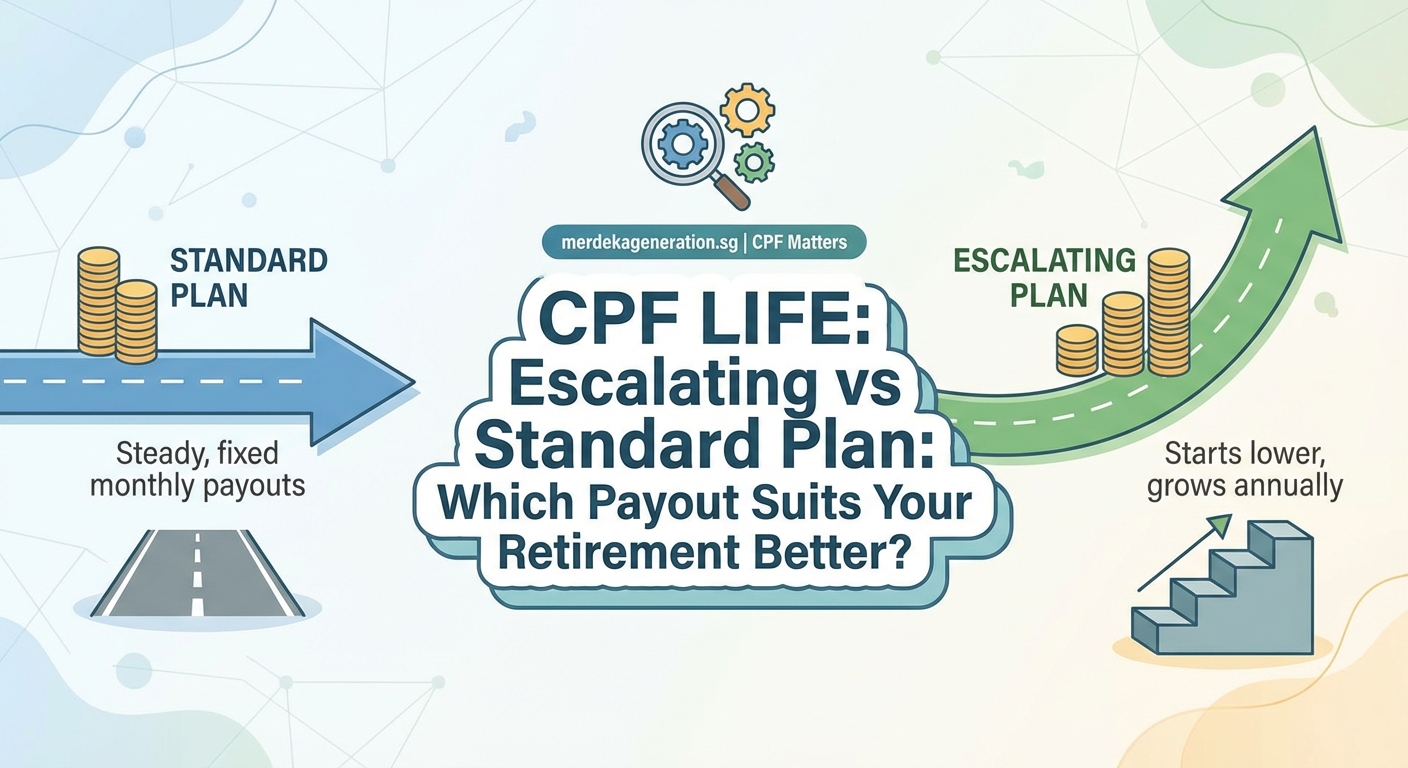
    • Escalating Plan: Lower starting payouts that increase over time to match inflation
    • Basic Plan: Higher monthly payouts with minimal bequest

    Your plan choice affects how much stays in your Retirement Account. The Basic Plan typically gives higher monthly amounts but leaves less for your loved ones.

    If you’re part of the Merdeka Generation, understanding how these plans work alongside your healthcare benefits becomes even more important for comprehensive retirement planning.

    Common withdrawal scenarios explained

    Let’s look at real situations to clarify how withdrawals work.

    Scenario 1: Uncle Tan has $250,000 in his Retirement Account

    He meets the Full Retirement Sum of $198,800. He can withdraw $51,200 immediately. His monthly CPF LIFE payout gets calculated based on the remaining $198,800.

    Scenario 2: Auntie Lim has $120,000 and pledged her HDB flat

    She meets the Basic Retirement Sum of $99,400 through property pledge. She can withdraw $20,600. Her monthly payouts come from the $99,400 set aside.

    Scenario 3: Mr Raj has $80,000 in his Retirement Account

    He doesn’t meet any retirement sum. He cannot make any withdrawal. All $80,000 funds his CPF LIFE payouts, though his monthly amount will be lower than someone with a fuller account.

    Scenario 4: Mdm Wong wants to withdraw at 65 but delays her payouts

    She can defer her CPF LIFE payouts up to age 70. During this deferral period, she cannot withdraw her Retirement Account savings. The money stays invested, earning interest, and her future monthly payouts will be higher.

    What you need to know about the Retirement Sum Scheme vs CPF LIFE

    Older members might be on the Retirement Sum Scheme instead of CPF LIFE. This affects withdrawal rules differently.

    The Retirement Sum Scheme applies to Singaporeans who turned 55 before 2009. Instead of lifelong payouts, you receive monthly income for about 20 years, calculated to last until around age 85 to 90.

    After your Retirement Sum Scheme payouts end, you can withdraw any remaining balance. This differs from CPF LIFE, which continues paying until you pass away.

    If you’re on the Retirement Sum Scheme, check your payout duration. Some members exhaust their Retirement Account before age 85, leaving them without CPF income in their later years.

    Mistakes to avoid when planning your withdrawal

    Many retirees make preventable errors that affect their financial security.

    Common Mistake Why It Hurts Better Approach
    Withdrawing maximum amount immediately Reduces monthly payout potential and leaves less buffer for emergencies Keep excess savings in CPF to earn higher interest rates
    Not checking property pledge status May think you can withdraw more than you actually can Verify your retirement sum type before turning 65
    Forgetting about Medisave requirements Medisave stays locked regardless of Retirement Account withdrawals Plan healthcare costs separately from retirement income
    Assuming all CPF is accessible Only amounts above retirement sums can be withdrawn Review your CPF statement months before turning 65
    Missing the deadline to choose CPF LIFE plan Gets placed on Standard Plan automatically Select your preferred plan before your 65th birthday

    The common mistakes that Merdeka Generation seniors make often extend to CPF withdrawals too. Being aware helps you avoid costly errors.

    Your Medisave Account at 65 and beyond

    While we’re focused on retirement savings, your Medisave Account operates under different rules.

    At 65, you must maintain the Basic Healthcare Sum in your Medisave Account. For 2024, this amount is $68,500. Any Medisave savings above this sum can be withdrawn.

    These withdrawals are separate from your Retirement Account withdrawals. You can access excess Medisave even if you haven’t met your Full Retirement Sum.

    Many seniors use excess Medisave to pay MediShield Life premiums or help family members with medical expenses. The funds can also go towards approved medical insurance or treatments.

    Your Medisave continues earning interest at higher rates than regular savings accounts. Leaving money in Medisave makes sense if you don’t need it immediately.

    How ongoing work affects your CPF at 65

    Still working at 65? Your employment status changes how CPF contributions work.

    Employers contribute to your retirement accounts at reduced rates after you turn 55. These contributions go to your Ordinary Account, Special Account, and Medisave Account based on allocation rates.

    Any new contributions to your Ordinary Account after 65 can be withdrawn immediately. They don’t get locked into your Retirement Account since that transfer only happens once at 55.

    This means working past 65 gives you more accessible cash through CPF. Your monthly salary contributions become available for withdrawal almost right away.

    Some seniors continue working specifically for this reason. The CPF contributions supplement their CPF LIFE payouts and provide extra flexibility.

    Planning your retirement income strategy

    Withdrawing CPF at 65 should fit into a broader retirement plan. Think about your total income sources.

    Your income might include:

    • Monthly CPF LIFE payouts
    • Lump sum withdrawal from excess retirement savings
    • Rental income from property
    • Part-time work or consultancy
    • Investment returns
    • Family support

    Calculate your monthly expenses realistically. Include healthcare costs, utilities, food, transport, and some buffer for unexpected needs.

    Compare your expected income against these expenses. If there’s a shortfall, consider whether withdrawing your excess CPF helps or whether keeping it invested makes more sense.

    The CPF Retirement Account earns up to 6% interest on the first $30,000 and up to 5% on the next $30,000. This beats most savings accounts and many conservative investments.

    For Merdeka Generation members, factoring in your annual MediSave top-up and other benefits provides a clearer picture of your actual retirement resources.

    What happens if you need more money urgently

    Sometimes life throws unexpected expenses your way. Medical emergencies, home repairs, or family needs might require more cash than your monthly payouts provide.

    If you’ve already withdrawn your excess CPF, you’ll need to look at other options:

    • Apply for government assistance schemes like ComCare
    • Use your Medisave for approved medical expenses
    • Consider a temporary loan from family members
    • Look into Silver Housing Bonus if you downsize your flat
    • Monetise your home through the Lease Buyback Scheme

    The Lease Buyback Scheme lets you sell part of your flat lease back to HDB. This tops up your Retirement Account, increasing your monthly payouts. It’s worth considering if you own an HDB flat and need more retirement income.

    Adjusting your CPF LIFE plan after 65

    You might regret your initial CPF LIFE plan choice. The good news is you can switch plans, but only once.

    You can change from the Standard Plan to the Escalating Plan or Basic Plan within a limited window. Contact CPF to understand your switching options based on when you started your payouts.

    Switching plans affects your monthly payout amount and the bequest your beneficiaries receive. Run the numbers carefully before making changes.

    The comparison between CPF LIFE plans helps you understand which option suits your situation better. Some seniors prefer higher immediate income, while others want payouts that keep pace with inflation.

    Special considerations for Merdeka Generation members

    If you’re part of the Merdeka Generation, born between 1950 and 1959, you have additional support beyond CPF.

    Your Merdeka Generation Package provides healthcare subsidies and MediSave top-ups. These benefits work alongside your CPF withdrawals and monthly payouts.

    The annual $200 MediSave top-up doesn’t affect your Retirement Account withdrawals. It goes directly to your Medisave Account for healthcare expenses.

    When planning your retirement finances, include these additional benefits in your calculations. They reduce your out-of-pocket healthcare costs significantly.

    If you’re unsure about your eligibility status, you can check if you qualify for the Merdeka Generation Package through official channels.

    Tax implications of CPF withdrawals

    CPF withdrawals at 65 are not taxable income in Singapore. You don’t need to declare them when filing your taxes.

    This applies to both lump sum withdrawals and monthly CPF LIFE payouts. The money has already been taxed when you earned it during your working years.

    However, if you invest your withdrawn CPF funds and earn returns, those investment gains might have tax implications depending on the investment type.

    Interest earned while your money sits in CPF accounts is also tax-free. This makes CPF an attractive place to keep retirement savings from a tax perspective.

    How property ownership affects your options

    Owning property changes your CPF withdrawal landscape significantly. Many Singaporeans used CPF for housing, which affects their Retirement Account balances.

    If you pledged your property to meet the Basic Retirement Sum, you have more flexibility. You can withdraw amounts above the Basic Retirement Sum instead of needing to meet the Full Retirement Sum.

    Selling your property later in retirement triggers CPF refunds. The proceeds must first refund what you withdrew for housing, plus accrued interest. Only after satisfying this refund can you keep the remaining cash.

    Some retirees downsize specifically to unlock CPF-related property value. Moving from a larger flat to a smaller one can free up cash while still maintaining the property pledge benefit.

    Making your withdrawal decision work for you

    Your CPF withdrawal choice at 65 shapes your retirement for years to come. Take time to think through your needs.

    Consider your health status. If you have medical conditions requiring ongoing treatment, keeping more in Medisave and maintaining higher CPF LIFE payouts might serve you better than a large withdrawal.

    Think about your family situation. Do you have dependents who rely on you financially? Will you need to help children or grandchildren with major expenses?

    Evaluate your risk tolerance. Money withdrawn from CPF and invested elsewhere carries market risk. CPF accounts offer guaranteed returns without market volatility.

    The right choice varies for everyone. A 65-year-old still working part-time has different needs than someone with health issues who stopped working years ago.

    For those helping elderly parents navigate these decisions, knowing how to help your parents claim all their benefits makes the process smoother for everyone involved.

    Getting help with your CPF decisions

    Don’t hesitate to seek guidance when making major financial decisions about your retirement savings.

    The CPF Board offers free advisory services. You can book appointments at service centres or call their hotline for specific questions about your account.

    Financial advisers can help you see the bigger picture, though make sure they’re qualified and registered with the Monetary Authority of Singapore.

    Community centres and senior activity centres sometimes run CPF education workshops. These sessions explain withdrawal rules in simple terms and let you ask questions in a comfortable setting.

    Family members can also attend CPF appointments with you. Having another set of ears helps you remember important details and make better decisions.

    Your retirement security starts with informed choices

    Understanding how to withdraw CPF at 65 gives you control over your retirement finances. The rules might seem complex at first, but they exist to protect your long-term security.

    Your withdrawal options depend on your retirement sum status, property situation, and CPF LIFE plan. Take time to review your CPF statement, understand your balances, and plan ahead before your 65th birthday arrives.

    Whether you can withdraw a substantial amount or nothing at all, knowing your situation helps you prepare. You can adjust other aspects of your retirement plan to compensate for limited CPF access or make smart decisions about excess savings.

    Your CPF journey doesn’t end at 65. It transforms into a reliable income source that supports you through your retirement years. Making informed decisions now sets you up for financial peace of mind in the decades ahead.


  • Should You Top Up Your CPF LIFE After 65? A Practical Guide for Merdeka Generation

    Should You Top Up Your CPF LIFE After 65? A Practical Guide for Merdeka Generation

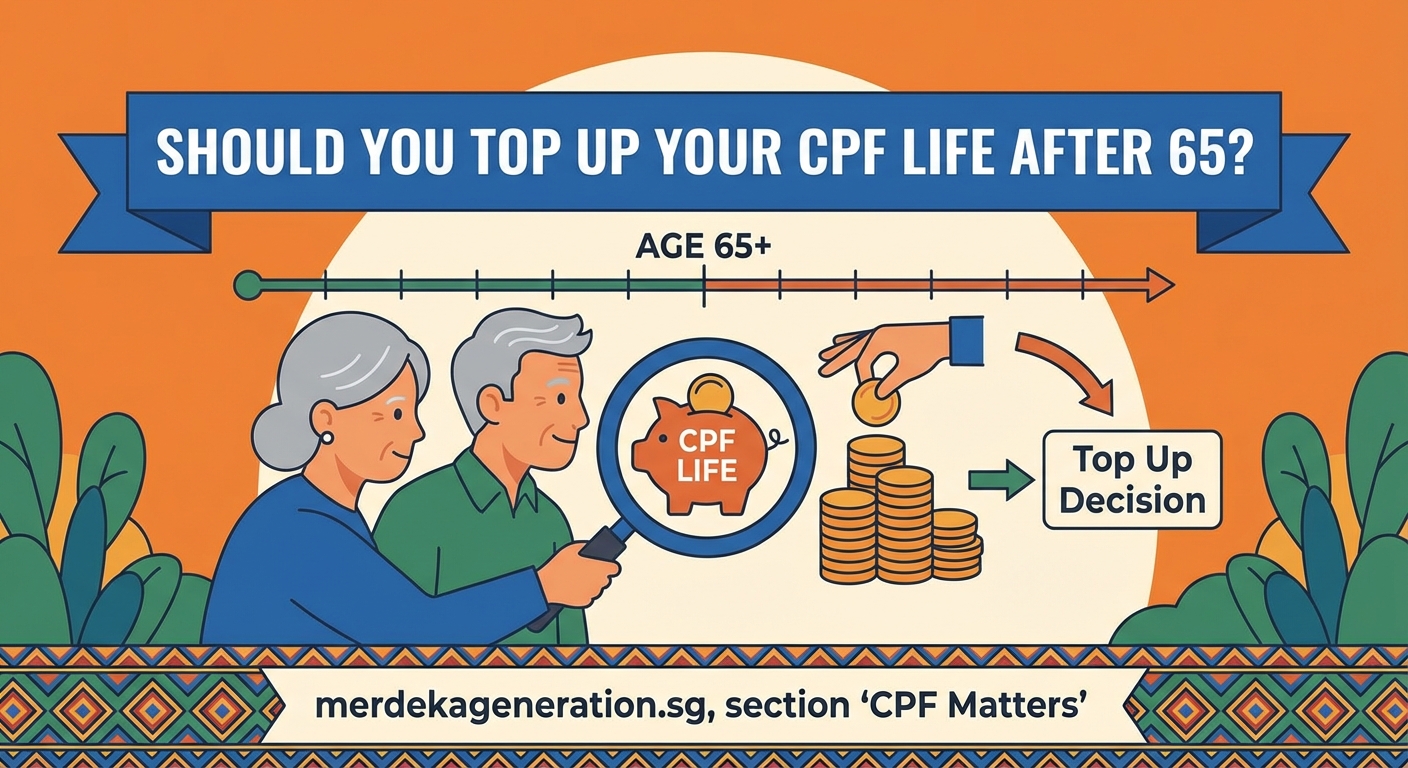
    You’ve turned 65, started receiving your CPF LIFE payouts, and now you’re wondering if it still makes sense to add more money into the system. It’s a fair question. After all, the rules around topping up your Retirement Account change once you hit this milestone, and not everyone explains what happens next.

    Key Takeaway

    You can still top up your CPF LIFE after 65, and it will increase your monthly payouts. However, you lose access to tax relief on these contributions, and the payout increase takes effect only from the following month. Merdeka Generation seniors should weigh this against other uses for their cash, especially if healthcare or family needs are pressing. Topping up makes most sense if you have spare funds and want guaranteed lifelong income.

    Can you still top up CPF LIFE once you’ve started receiving payouts?

    Yes, you can.

    Many people assume that once CPF LIFE payouts begin at 65, the door closes on voluntary contributions. That’s not true. You can continue making cash top-ups to your Retirement Account even after payouts have started.

    The CPF Board will recalculate your monthly payout based on the new balance. The adjustment happens from the month after your top-up is credited. So if you top up in March, your April payout will reflect the increase.

    But there’s a catch. You won’t enjoy tax relief anymore. The government allows tax relief only for top-ups made before you turn 65 or before your payouts start, whichever comes first. Once you’re past that line, every dollar you add is purely for boosting your monthly income, not for reducing your tax bill.

    For Merdeka Generation members who are already receiving healthcare subsidies and the annual $200 top-up, this might feel like a trade-off worth considering. If you qualify for the Merdeka Generation Package, you’re already getting some financial cushioning. The question is whether adding more to CPF LIFE is the best use of your spare cash.

    How much will your payout increase if you top up after 65?

    Should You Top Up Your CPF LIFE After 65? A Practical Guide for Merdeka Generation — image 1

    The increase depends on how much you add and which CPF LIFE plan you’re on.

    CPF uses an actuarial formula to convert your top-up into additional monthly income. The exact amount varies based on your age, gender, and the plan you selected when you turned 65. Generally, the older you are when you top up, the higher the monthly increase per dollar added, because the payout period is shorter.

    Here’s a simplified example. If you’re 66 and you top up $10,000, you might see your monthly payout rise by around $50 to $70. If you’re 70 and you top up the same amount, the increase could be closer to $80 to $100. These are rough estimates. The CPF website provides calculators, but they don’t always account for post-65 top-ups clearly. You may need to call the CPF hotline for a precise figure.

    One thing to note is that the payout increase is permanent. Once it’s recalculated, you’ll receive that higher amount every month for the rest of your life. If you live another 20 years, that $10,000 top-up could translate into tens of thousands of dollars in total payouts.

    But if you need that $10,000 for medical bills, home repairs, or helping your children, the calculation changes. CPF LIFE is not liquid. Once the money goes in, you can’t pull it out except through monthly payouts.

    What are the practical steps to top up your Retirement Account after 65?

    Topping up is straightforward. Here’s how you do it.

    1. Log in to the CPF website using your Singpass.
    2. Navigate to the “My Request” section and select “Apply for Top-Up”.
    3. Choose “Retirement Account” as the destination.
    4. Enter the amount you want to top up and confirm the transaction.
    5. Make payment via PayNow, eNETS, or GIRO.

    The money is usually credited within one to two working days. Your new payout amount will take effect from the following month.

    If you’re not comfortable with online banking, you can also visit a CPF Service Centre and make the top-up in person. Bring your NRIC and the cash or cheque you want to contribute.

    One common mistake is topping up too close to the end of the month. If your contribution is credited after the payout for that month has been processed, you’ll have to wait another month to see the increase. Plan ahead if you want the adjustment to kick in sooner.

    Also, remember that there’s no maximum limit for cash top-ups to your own Retirement Account after 65. However, if you’re topping up for someone else, like a spouse or parent, the annual limit is $8,000 per recipient.

    Should you top up if you’re also receiving Merdeka Generation benefits?

    Should You Top Up Your CPF LIFE After 65? A Practical Guide for Merdeka Generation — image 2

    This is where your personal situation matters most.

    Merdeka Generation members already enjoy subsidies on outpatient care, MediShield Life premiums, and the annual $200 PAssist top-up. If your healthcare costs are well covered and you have surplus income, topping up CPF LIFE can be a safe way to lock in more retirement income.

    But if you’re relying on those subsidies because money is tight, adding more to CPF LIFE might not be the best move. You can’t use CPF LIFE payouts to pay for immediate expenses like a hospital bill or a family emergency. Cash in hand is more flexible.

    Consider this scenario. You’re 67, and you have $15,000 in savings. You could top up $10,000 to CPF LIFE and boost your monthly payout by $80. Or you could keep that $10,000 accessible in case you need specialist treatment, dental work, or help with a grandchild’s education. If you’re in good health and your expenses are predictable, the top-up might make sense. If you’re managing chronic conditions or supporting family members, liquidity might be more valuable.

    Another angle is longevity. If your parents lived into their 90s and you expect to do the same, the guaranteed lifelong income from CPF LIFE becomes more attractive. If your family history suggests a shorter lifespan, you might prefer to keep your money outside the system.

    There’s no one-size-fits-all answer. The decision hinges on your health, your expenses, and your comfort with locking money away.

    What are the common mistakes people make when topping up after 65?

    Here are the pitfalls to watch out for.

    Mistake Why It Happens How to Avoid It
    Expecting tax relief People assume top-ups always qualify for relief Check your age and payout start date before topping up
    Topping up without checking payout increase Assume the increase will be significant Use the CPF calculator or call the hotline for estimates
    Draining emergency savings Focus on maximising CPF LIFE without keeping cash reserves Keep at least six months of expenses in accessible savings
    Topping up too late in the month Want the increase to start immediately Top up by the 15th of the month to ensure timely processing
    Ignoring spousal needs Top up own account but neglect spouse’s retirement income Consider splitting top-ups between both accounts if married

    One mistake that doesn’t get talked about enough is ignoring the impact on your family. If you pass away, your CPF LIFE balance doesn’t go to your estate in full. Your beneficiaries receive the remaining premium balance, minus payouts already received. If you’ve topped up heavily and pass away early, your family might get back less than you put in. That’s the trade-off for guaranteed lifelong income.

    Another misstep is topping up without comparing alternatives. If you have $20,000 to spare, you could top up CPF LIFE, or you could use that money to pay off high-interest debt, invest in a diversified portfolio, or even gift it to your children while you’re alive. CPF LIFE offers safety and certainty, but it’s not the only option.

    How does topping up after 65 compare to topping up before 65?

    The main difference is tax relief.

    Before 65, you can claim up to $8,000 in tax relief for top-ups to your own Retirement Account, and another $8,000 for top-ups to family members. That’s a significant incentive if you’re still earning taxable income.

    After 65, that benefit disappears. Every dollar you add is purely for income, not tax savings. For retirees who are no longer working and have no taxable income anyway, this doesn’t change much. But for those who are still employed part-time or receiving rental income, the loss of tax relief is a real cost.

    Another difference is flexibility. Before 65, you can still withdraw your CPF savings under certain conditions, such as for housing or approved investments. After 65, once money goes into the Retirement Account, it’s locked into the payout system. You can’t redirect it or withdraw it as a lump sum.

    The payout increase formula also changes slightly with age. The older you are, the higher the monthly increase per dollar topped up, because the payout period is shorter. This means topping up at 70 gives you a bigger monthly boost than topping up at 66, even if you add the same amount.

    But here’s the trade-off again. If you top up at 66, you’ll receive that increased payout for more years, assuming you live a long life. If you top up at 70, the monthly increase is higher, but you’ll collect it for fewer years. The break-even point depends on how long you live.

    What if you need the money later?

    This is the hardest part of the decision.

    CPF LIFE is designed to be irreversible. Once you top up, you can’t change your mind and withdraw the money. If you face a financial emergency, like a major medical expense or a family crisis, you’ll have to rely on other resources.

    That’s why financial planners often recommend keeping a separate emergency fund before topping up CPF LIFE. A good rule of thumb is to have at least six to twelve months of living expenses in cash or easily accessible savings. Only after that safety net is in place should you consider locking more money into CPF LIFE.

    For Merdeka Generation seniors, this is especially important. Healthcare costs can escalate unexpectedly, even with subsidies. If you’ve topped up all your spare cash and then need $20,000 for surgery, you’ll be stuck. Your CPF LIFE payout won’t suddenly increase to cover the shortfall. You’ll need to borrow, sell assets, or rely on family.

    On the other hand, if you’re confident that your Merdeka Generation benefits, MediShield Life, and personal savings are enough to cover emergencies, then topping up CPF LIFE can provide peace of mind. You’ll know that your monthly income is secure, no matter how long you live or what happens in the financial markets.

    “CPF LIFE is not for everyone, but for those who value certainty and don’t need liquidity, it’s one of the safest retirement income tools available. Just make sure you’re not sacrificing flexibility for security.” – Financial planner with 20 years of experience advising retirees.

    Are there alternatives to topping up CPF LIFE after 65?

    Yes, several.

    One option is to keep your money in a high-interest savings account. Some banks offer senior-friendly accounts with better rates. You won’t get the guaranteed lifelong income of CPF LIFE, but you’ll retain access to your funds.

    Another option is to invest in low-risk instruments like Singapore Savings Bonds or fixed deposits. These won’t match the longevity insurance of CPF LIFE, but they offer liquidity and modest returns.

    If you’re comfortable with some risk, you could also consider a diversified portfolio of bonds and dividend-paying stocks. This requires more active management, but it can provide both income and capital growth. Just be aware that market volatility can affect your returns, especially in the short term.

    For those who want to help their children or grandchildren, gifting money while you’re alive can be more rewarding than leaving it in CPF LIFE. You’ll see the impact of your generosity, and your family will benefit sooner.

    Finally, some people choose to spend the money on experiences. Travel, hobbies, or upgrading their living conditions. After all, retirement is meant to be enjoyed. If you’ve saved diligently all your life, it’s okay to use some of that money for yourself.

    The key is balance. You don’t have to put all your spare cash into CPF LIFE, but you also don’t have to avoid it entirely. A mix of guaranteed income, accessible savings, and discretionary spending is often the healthiest approach.

    How to decide if topping up is right for you

    Start by asking yourself these questions.

    • Do I have at least six months of expenses in accessible savings?
    • Am I in good health, or do I expect significant medical costs in the near future?
    • Do I have family members who depend on me financially?
    • How long do I expect to live, based on my health and family history?
    • Do I value guaranteed income more than liquidity?

    If you answered yes to the first question and no to the third, topping up might make sense. If you’re managing chronic conditions or supporting others, you might want to hold off.

    Another useful exercise is to calculate the break-even point. Divide the amount you plan to top up by the monthly payout increase. That gives you the number of months it will take to recover your contribution. If you expect to live longer than that, the top-up is financially sound.

    For example, if you top up $12,000 and your payout increases by $80 per month, your break-even point is 150 months, or 12.5 years. If you’re 66 and expect to live past 78, the top-up makes sense. If your health is poor and you’re unsure about reaching that age, you might prefer to keep the money accessible.

    Also, consider your other retirement income sources. If you’re receiving rental income, a pension, or support from your children, you might not need to maximise CPF LIFE. If CPF LIFE is your only guaranteed income, topping up becomes more attractive.

    Finally, talk to your family. If your spouse or children have strong opinions about how you use your money, it’s worth involving them in the decision. They might have insights you haven’t considered, or they might help you see priorities you’ve overlooked.

    Making the most of your retirement income as a Merdeka Generation senior

    Topping up CPF LIFE after 65 is not a magic solution, but it’s a solid tool if used wisely.

    For Merdeka Generation members, the combination of government subsidies, healthcare support, and CPF LIFE can create a stable foundation for retirement. Adding more to CPF LIFE strengthens that foundation, but only if it doesn’t come at the cost of flexibility or family support.

    Think of it this way. CPF LIFE is like buying insurance for longevity. You’re paying upfront for the guarantee that you’ll never run out of money, no matter how long you live. That’s valuable. But like any insurance, it comes with trade-offs. You lose access to the premium, and if you don’t live long enough, you might not get full value.

    The best approach is to treat CPF LIFE as one piece of a larger retirement plan. Keep some money accessible for emergencies. Allocate some for enjoyment. And if you have surplus funds that you don’t need in the short term, consider topping up CPF LIFE to secure a higher baseline income.

    If you’re still unsure, reach out to a financial adviser who understands the needs of Merdeka Generation seniors. They can help you model different scenarios and make a choice that fits your situation. And if you’re making mistakes with your benefits claims, fixing those first might free up more resources for retirement planning.

    Retirement is not just about numbers. It’s about peace of mind, dignity, and the ability to live comfortably without constant worry. Topping up CPF LIFE can contribute to that, but only if it’s part of a thoughtful, balanced plan that reflects your values and priorities.