
Watching your parent fumble through their wallet for three different subsidy cards at the clinic counter feels all too familiar. You’re juggling work calls, your own family, and now trying to figure out which card covers what, whether MediSave can pay for this visit, and why the receptionist is asking about Healthier SG enrolment.
Managing elderly parents medical appointments in Singapore doesn’t have to feel like solving a puzzle blindfolded. The subsidies exist to help, but only if you know how to use them properly.
Adult children managing their parents’ healthcare in Singapore can maximise CHAS, MediSave, and Merdeka Generation subsidies by understanding eligibility requirements, keeping organised medical records, coordinating appointments strategically, and avoiding common claiming mistakes. Proper preparation and documentation ensure your parents receive entitled benefits without unnecessary out-of-pocket expenses or rejected claims.
Understanding the three main subsidy schemes your parents can access
Your parents likely qualify for multiple healthcare subsidies, but each serves a different purpose.
The Community Health Assist Scheme (CHAS) provides subsidies at participating GP clinics and dental practices. All Singaporeans now qualify automatically, with subsidy levels based on household income. Your parents don’t need to apply separately if they’re already citizens.
MediSave functions as a healthcare savings account under CPF. Your parents can use it to pay for approved outpatient treatments, day surgery, and certain chronic condition medications. The catch? Annual withdrawal limits apply, and not every medical expense qualifies.
The Merdeka Generation Package offers additional benefits for Singaporeans born in the 1950s. This includes extra subsidies for outpatient care, MediSave top-ups, and enhanced support for long-term care needs. If you’re unsure about how to check if you qualify for the Merdeka Generation package in 2024, verification takes just a few minutes online.
These schemes stack. Your mother’s GP visit might use CHAS for the consultation subsidy, MediSave for medication, and the Merdeka Generation card for additional discounts.
Setting up a medical appointment system that actually works
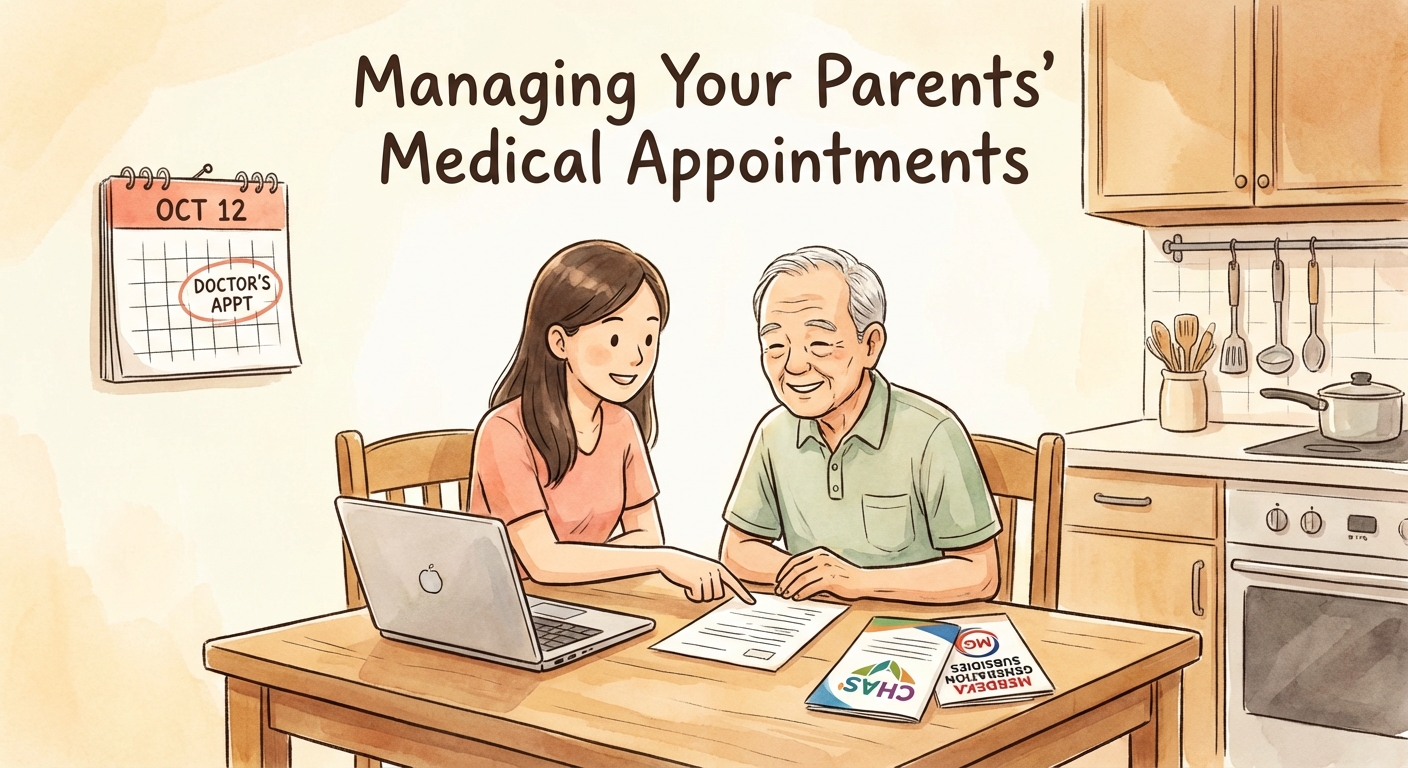
Coordinating multiple doctor visits requires more than just remembering dates.
Create a shared calendar that everyone can access. Google Calendar works well because you can set reminders for both you and your parents. Colour-code appointments by type: red for specialist visits, blue for routine check-ups, green for dental or eye care.
Keep a master document with all relevant information:
- Doctor names and clinic contact numbers
- Appointment dates and times
- Required documents for each visit
- Questions to ask during consultations
- Follow-up tasks after appointments
Store this document in the cloud so you can access it from your phone while at work or during emergencies.
Schedule appointments strategically. Mornings typically see shorter wait times at polyclinics. Avoid Mondays when clinics get busier with weekend backlog. If your father sees multiple specialists, try clustering appointments on the same day to reduce transport trips.
Book follow-ups before leaving the clinic. Waiting until you get home often means forgetting, then scrambling weeks later when symptoms worsen.
Preparing for appointments to maximise subsidy claims
Walking into a clinic unprepared costs time and money.
Bring these items to every appointment:
- NRIC (essential for all subsidy verification)
- CHAS card or confirmation of automatic enrolment
- Merdeka Generation card if applicable
- Current medication list with dosages
- Recent test results or medical reports
- Insurance cards if your parents have private coverage
Many adult children forget the medication list. Clinics waste valuable consultation time trying to identify pills from descriptions like “the small white one for blood pressure.” Take photos of all medication bottles with labels clearly visible. Update these photos monthly.
“Half of subsidy claim rejections happen because patients can’t produce the right identification at the point of service. Always carry original documents, not photocopies, especially for first visits to new clinics.”
Verify subsidy eligibility before the appointment. Call the clinic to confirm they accept CHAS and participate in relevant schemes. Not all GP clinics accept MediSave for chronic disease management, even if they display CHAS stickers.
Ask about bulk billing options. Some clinics can submit MediSave claims directly without requiring upfront cash payment. This prevents situations where your parents pay first, then struggle with reimbursement paperwork later.
Common mistakes that waste subsidies and how to avoid them
Even well-meaning caregivers make errors that reduce subsidy benefits.
| Mistake | Why It Happens | How to Fix It |
|---|---|---|
| Using wrong card for payment | Multiple cards cause confusion | Label cards clearly with usage notes |
| Missing annual MediSave limits | Unaware of withdrawal caps | Track spending monthly in spreadsheet |
| Forgetting to bring subsidy cards | Rushed morning departures | Keep duplicates in parent’s regular bag |
| Not updating household income | Life changes affect eligibility | Review CHAS tier annually in January |
| Paying cash when MediSave applies | Clinic doesn’t mention option | Always ask “Can we use MediSave?” |
The $200 annual Merdeka Generation top-up disappears if unused. Many seniors don’t realise this credit expires. Learn more about understanding your $200 annual MG card top-up to avoid leaving money on the table.
Never assume subsidies apply automatically. Clinic staff sometimes forget to apply discounts, especially during busy periods. Check the bill before payment and question any charges that seem higher than expected.
Navigating specialist referrals and hospital appointments
Specialist care introduces additional complexity to subsidy management.
Polyclinic referrals unlock subsidised specialist rates at public hospitals. Private GP referrals don’t provide the same subsidy levels. If your parent needs a cardiologist or orthopaedic surgeon, route through the polyclinic first, even if it means an extra appointment.
Waiting times for subsidised specialist appointments can stretch to months. Book immediately after receiving the referral letter. Don’t wait to “see if the condition improves.” You can always cancel if unnecessary, but rebooking pushes you to the back of the queue.
Hospital bills work differently from clinic visits. MediSave withdrawal limits increase for inpatient care and day surgery. MediShield Life, Singapore’s basic health insurance, covers large hospital bills with annual limits and deductibles. Your parents likely have this coverage automatically, but verify the details to understand out-of-pocket costs.
For planned procedures, request a cost estimate beforehand. Hospitals can provide breakdown of expected charges, subsidy amounts, and what MediSave or MediShield Life will cover. This prevents billing shock after discharge.
Keeping medical records organised across multiple providers
Your father sees a GP, cardiologist, endocrinologist, and physiotherapist. Each keeps separate records that rarely communicate.
Create a medical binder or digital folder with these sections:
- Current medications and dosages
- Chronic conditions and diagnosis dates
- Allergies and adverse reactions
- Recent lab results and test reports
- Vaccination records
- Specialist consultation summaries
- Hospital discharge summaries
Update this record after every appointment. Doctors make better decisions when they see the full picture, not just their specialty’s slice.
Request copies of all test results and reports. You’re entitled to your parent’s medical records. Some clinics charge small fees for printouts, but the investment pays off when a new doctor needs historical context.
Photograph or scan important documents. Cloud storage like Google Drive or Dropbox ensures you can access records from anywhere. Tag files with dates and doctor names for easy searching.
If your parent has multiple chronic conditions requiring regular medication, CPF MediSave for seniors becomes crucial for managing ongoing costs without depleting savings.
Coordinating care between family members
Caregiving shouldn’t fall entirely on one child’s shoulders.
Assign specific responsibilities among siblings:
- One person handles appointment scheduling
- Another manages medication refills and organisation
- Someone tracks subsidy claims and medical expenses
- A family member attends appointments and takes notes
Create a shared WhatsApp group for medical updates. After each appointment, post a brief summary: what the doctor said, any medication changes, next appointment date, and action items.
Rotate appointment attendance if possible. Fresh ears catch details the regular attendee might miss through familiarity. Different children also ask different questions based on their concerns.
Some families resist sharing medical information, viewing it as the parent’s private matter. This privacy comes at a cost when emergencies happen and siblings don’t know current medications or recent diagnoses. Have an honest conversation with your parents about sharing necessary medical information among trusted family members.
Handling rejected subsidy claims and appeals
Claims get rejected. Knowing how to respond saves money.
Common rejection reasons include:
- Treatment not covered under the specific scheme
- Annual MediSave withdrawal limit exceeded
- Missing or incorrect documentation
- Service provided by non-participating clinic
- Claim submitted outside the allowed timeframe
Read rejection notices carefully. They typically explain the specific reason and whether you can appeal. Don’t ignore these letters or assume the decision is final.
For CHAS-related issues, contact the clinic first. Sometimes simple administrative errors cause rejections, and clinic staff can resubmit corrected claims. For MediSave rejections, call CPF directly at their hotline. Have your parent’s NRIC and claim details ready.
Document everything during the appeals process. Keep copies of:
- Original bills and receipts
- Rejection notices
- Medical reports supporting treatment necessity
- Correspondence with authorities
- Resubmission confirmations
Appeals take time, sometimes several weeks. Follow up if you don’t receive responses within the stated timeframe. Persistence often makes the difference between successful appeals and abandoned claims.
Understanding what to do when your healthcare subsidy claim gets rejected can help you navigate the appeals process more effectively.
Planning ahead for increased care needs
Your parents’ healthcare needs will grow, not shrink.
Start conversations about future care preferences now, while everyone’s thinking clearly. Discuss:
- Preferred hospitals or healthcare providers
- Comfort with different types of treatments
- Home care versus nursing home preferences
- Financial limits for medical spending
- End-of-life care wishes
These conversations feel uncomfortable but become impossible during medical crises when decisions need making under pressure.
Review insurance coverage gaps. MediShield Life provides basic coverage, but consider whether Integrated Shield Plans or critical illness policies make sense for your family situation. The decision depends on your parents’ health status, existing savings, and your family’s ability to cover potential medical bills.
Set aside emergency medical funds. Even with full subsidies, co-payments and uncovered expenses add up. A dedicated savings account for parent healthcare costs prevents scrambling when unexpected medical needs arise.
Consider whether managing healthcare costs in retirement requires additional financial planning beyond government subsidies.
Making technology work for elderly parents
Apps and online portals can simplify healthcare management, but only if your parents can actually use them.
HealthHub consolidates medical records, appointment bookings, and subsidy information in one place. Help your parents set up an account and show them how to:
- View upcoming appointments
- Check vaccination records
- Access lab results
- Submit MediSave claims
- Verify CHAS eligibility
Don’t just set it up and leave. Sit with them through several practice sessions. Write down step-by-step instructions with screenshots. Many seniors can learn digital tools with patience and repetition.
For parents who resist technology, hybrid systems work better. You manage the digital aspects while they keep physical copies of important information. Create a simple paper checklist they can follow for appointment preparation.
Medication reminder apps help with adherence. Programs like Medisafe send notifications when it’s time to take pills. Set these up on your parent’s phone with large, clear labels and simple interfaces.
Some seniors prefer human contact over apps. That’s fine. The goal is reliable healthcare management, not forcing technology adoption. Use whatever system your parents will actually follow consistently.
When to consider professional care coordination help
Sometimes family caregiving reaches its limits.
Signs you might need professional help:
- Missing appointments frequently despite best efforts
- Medication errors happening regularly
- Multiple emergency room visits for preventable issues
- Family conflicts over care decisions
- Your own health or work suffering significantly
Care coordinators or geriatric care managers provide professional appointment scheduling, medication management, and healthcare navigation. They cost money but often save more through better subsidy utilisation and preventing expensive emergency care.
Some hospitals offer care coordination services for complex cases. Ask your parent’s primary doctor whether such programs exist and how to access them.
Community resources like senior activity centres sometimes provide healthcare navigation assistance. These services often cost less than private care managers while still offering valuable support.
Staying informed about subsidy changes and updates
Healthcare policies change regularly. What worked last year might not apply today.
Subscribe to official government updates:
- MOH website announcements
- CPF Board email notifications
- CHAS scheme updates
- Merdeka Generation programme changes
Check these sources quarterly, not just when problems arise. Policy changes often include expanded benefits or new covered services that could help your parents.
Join caregiver support groups, either online or in person. Other adult children managing parent healthcare often share valuable tips about navigating subsidies and finding good healthcare providers.
Attend health screening talks at community centres. These sessions frequently include updates about available subsidies and how to access them. Plus, they’re often free with light refreshments.
If your parent lost their Merdeka Generation card, knowing the replacement process prevents gaps in subsidy access.
Your parents deserve care without financial stress
Managing elderly parents medical appointments in Singapore becomes manageable once you understand the subsidy landscape and build reliable systems.
The effort you invest now in learning CHAS, MediSave, and Merdeka Generation benefits pays dividends for years. Your parents receive better care, you spend less time firefighting medical crises, and everyone experiences less financial anxiety around healthcare costs.
Start with one improvement this week. Maybe it’s creating that shared medical calendar, or finally requesting copies of your mother’s recent test results, or verifying your father’s CHAS tier eligibility.
Small steps compound. Six months from now, you’ll handle medical appointments with confidence instead of confusion, knowing exactly which subsidies apply and how to access them properly.
Leave a Reply