Category: Retirement Planning

  • Creating a Monthly Budget That Works on Fixed CPF LIFE and Pension Income

    Creating a Monthly Budget That Works on Fixed CPF LIFE and Pension Income

    Retirement in Singapore looks different when your income stops growing and starts flowing at a fixed rate each month. Your CPF LIFE payouts arrive like clockwork, your pension deposits land on schedule, but unlike your working years, there’s no overtime pay or annual bonus to cushion unexpected expenses. The numbers stay the same month after month, which means your budgeting approach needs to change too.

    Key Takeaway

    Budgeting on fixed retirement income in Singapore requires knowing your exact monthly payouts, separating essential from flexible expenses, building a small buffer for healthcare costs, and making the most of Merdeka Generation benefits. Track spending patterns for three months, then adjust categories based on real costs rather than estimates to create a sustainable monthly plan.

    Understanding Your Fixed Income Sources

    Most Singaporean retirees receive money from two or three predictable sources. CPF LIFE provides monthly payouts that continue for life. Some receive pension income from former employers. Others might have rental income from property or annuity payments.

    The first step in budgeting is writing down each income source and its exact amount. Check your CPF LIFE payout amount through your Singpass account. Note when pension payments arrive, whether monthly or quarterly. Add up rental income after deducting property tax and maintenance costs.

    These numbers become your spending ceiling. Unlike working years when you could ask for a raise or take on extra projects, fixed income means exactly that. Fixed.

    For Merdeka Generation seniors born between 1950 and 1959, the government provides additional support through healthcare subsidies and MediSave top-ups. These benefits reduce your healthcare spending burden, freeing up more of your monthly income for other needs.

    Calculating Your True Monthly Income

    Your CPF LIFE statement shows your monthly payout, but that’s not always what hits your bank account. Some retirees have insurance premiums deducted automatically. Others set aside MediSave contributions or help adult children with loan payments.

    Calculate your take-home amount by subtracting automatic deductions from your gross income. This gives you the actual spending money available each month.

    Here’s a simple calculation:

    1. Add all monthly income sources (CPF LIFE, pension, rental, annuities)
    2. Subtract automatic deductions (insurance, loan commitments, standing orders)
    3. The result is your true monthly budget

    If your CPF LIFE payout is $1,400, your pension is $600, and you have $200 deducted for insurance, your actual monthly budget is $1,800. That’s the number that matters for daily spending decisions.

    “Many retirees make the mistake of budgeting based on their gross income rather than what actually reaches their bank account. This leads to overspending and stress when bills arrive.” — Financial counsellor at RSVP Singapore

    Separating Essential from Flexible Spending

    Not all expenses carry equal weight. Some you must pay regardless. Others you can adjust when money gets tight.

    Essential expenses include:

    • Housing costs (conservancy charges, utilities, property tax)
    • Food and groceries
    • Healthcare and medication
    • Insurance premiums
    • Transport for medical appointments

    Flexible expenses include:

    • Entertainment and dining out
    • Gifts and donations
    • Travel and holidays
    • Hobby supplies
    • Upgraded groceries or premium brands

    Track both categories separately for three months. You’ll spot patterns. Maybe your grocery bill spikes when grandchildren visit. Perhaps utilities jump during hot months when you run the air conditioner more.

    The annual MG card top-up of $200 helps offset medical costs, but timing matters. Plan larger healthcare expenses around when this top-up arrives to maximise its benefit.

    The 50-30-20 Rule Adapted for Retirees

    The classic budgeting rule suggests spending 50% on needs, 30% on wants, and saving 20%. Retirees need a different split because healthcare costs rise while income stays flat.

    Try this modified approach for Singapore retirees:

    • 60% for essential expenses (housing, food, healthcare, utilities)
    • 25% for flexible spending (entertainment, gifts, discretionary items)
    • 15% for emergency buffer and unexpected costs

    If your monthly income is $2,000, that means $1,200 for essentials, $500 for wants, and $300 set aside for emergencies or larger irregular expenses like spectacles or dental work.

    This split recognises that healthcare becomes less predictable with age. The 15% buffer grows into a cushion for months when medical bills spike or appliances need replacing.

    Building Your Monthly Budget Step by Step

    Creating a working budget takes more than guessing at expenses. Follow these steps:

    1. List every income source with exact amounts and payment dates
    2. Write down all fixed monthly expenses (utilities, phone, insurance, conservancy)
    3. Estimate variable costs based on three months of actual spending
    4. Add a 10% buffer for price increases and unexpected costs
    5. Subtract total expenses from total income
    6. Adjust flexible spending if expenses exceed income

    Most retirees find their first budget attempt shows a shortfall. That’s normal. The exercise reveals where money actually goes versus where you think it goes.

    Common surprises include:

    • Higher transport costs than expected
    • Eating out more frequently than remembered
    • Gifts and ang baos adding up significantly
    • Replacement costs for clothing and household items

    Managing Healthcare Costs Within Your Budget

    Healthcare represents the biggest variable expense for retirees. A good month might cost $100. A bad month with specialist visits and new medications could hit $800.

    Merdeka Generation seniors receive substantial healthcare subsidies. Maximising your MediShield Life coverage reduces out-of-pocket costs for hospital stays and major procedures.

    The CHAS card provides subsidies for general practitioner and dental visits at participating clinics. Using CHAS clinics instead of private doctors saves $20 to $40 per visit.

    Budget for healthcare using a three-tier approach:

    • Regular monthly costs: Chronic disease medication, routine check-ups
    • Quarterly costs: Specialist visits, health screenings
    • Annual costs: Dental work, spectacles, hearing aids

    Set aside money monthly for quarterly and annual expenses. If dental work costs $600 annually, save $50 monthly so the money’s ready when needed.

    Keep $500 to $1,000 in an easily accessible account specifically for medical emergencies. This prevents raiding your food or utilities budget when health issues arise unexpectedly.

    Tracking Spending Without Complicated Apps

    You don’t need fancy software to track retirement spending. A simple notebook works fine. So does a basic spreadsheet.

    Record every expense for three months. Write down what you spent, when, and what category it falls under. This reveals patterns invisible when you just swipe your card or hand over cash.

    After three months, you’ll know:

    • Your true average monthly grocery cost
    • How much you actually spend on transport
    • Whether utility bills vary by season
    • How much goes to entertainment and eating out

    Use this real data to build next month’s budget. Estimates based on actual spending beat guesses every time.

    Some retirees prefer the envelope method. Withdraw your monthly budget in cash. Divide it into envelopes labelled groceries, transport, entertainment, utilities. When an envelope empties, spending in that category stops until next month.

    This physical system makes spending limits tangible. You can see and feel how much remains for each category.

    Common Budgeting Mistakes and How to Avoid Them

    Mistake Why It Happens Better Approach
    Forgetting annual expenses Only tracking monthly costs List all yearly expenses, divide by 12, include in monthly budget
    No healthcare buffer Assuming good health continues Set aside 15% monthly for medical costs and emergencies
    Overspending early in month Money feels abundant when it first arrives Allocate money to categories immediately upon receipt
    Ignoring small daily expenses Coffee, snacks, newspapers seem insignificant Track everything for one month to see true impact
    Not adjusting for inflation Using same budget year after year Review and update budget every six months
    Skipping the emergency fund Assuming CPF withdrawal covers emergencies Build $3,000 to $5,000 buffer over time

    The mistakes Merdeka Generation seniors make when claiming benefits often stem from not understanding what’s available. Missing subsidies means paying more from your monthly budget than necessary.

    Stretching Your Fixed Income Further

    Small changes compound into significant savings over time. Consider these practical adjustments:

    Reduce utility costs: Run air conditioning only in occupied rooms. Use fans when temperature permits. Wash clothes in cold water. These changes can cut electricity bills by 20% to 30%.

    Shop at neighbourhood markets: Wet markets and neighbourhood shops often charge less than supermarkets for fresh produce and staples. Shopping early morning gets you better selection and sometimes lower prices.

    Cook larger portions: Prepare meals that provide leftovers for next day’s lunch. This reduces both grocery costs and the temptation to eat out.

    Use senior discounts: Many retailers, restaurants, and services offer senior discounts. Always ask, even if no sign advertises it.

    Review insurance coverage: Some retirees carry insurance products bought decades ago that no longer fit their needs. Understanding what you actually need prevents paying for unnecessary coverage.

    Consider transport alternatives: Senior concession cards reduce public transport costs. For regular routes, monthly passes beat paying per trip.

    Adjusting When Income Doesn’t Cover Expenses

    Sometimes the numbers simply don’t work. Monthly expenses exceed fixed income no matter how carefully you budget.

    Several options exist:

    Reduce housing costs: Downsizing your HDB flat releases capital and lowers monthly conservancy charges and utilities. Moving from a four-room to a three-room flat might free up $100,000 while cutting monthly costs by $200.

    Supplement with part-time work: Many retirees work part-time, not just for money but for social connection and purpose. Even $400 monthly from part-time work significantly eases budget pressure.

    Tap CPF savings strategically: If you have excess CPF savings beyond your retirement account, withdrawing at 65 provides flexibility. Use withdrawn funds to pay off debts or create an emergency buffer.

    Increase CPF LIFE payouts: Topping up your CPF LIFE after 65 increases monthly payouts. If you receive a lump sum from property sale or inheritance, putting some into CPF LIFE boosts guaranteed monthly income.

    Seek family support: Many adult children help parents with specific expenses like medical costs or utilities. Having honest conversations about financial needs prevents stress and uncertainty.

    Planning for Irregular Expenses

    Fixed monthly income meets regular expenses reasonably well. The challenge comes from irregular costs that pop up unpredictably.

    Create a separate list of annual or occasional expenses:

    • Property tax (annual)
    • Insurance premiums (annual or quarterly)
    • Spectacles replacement (every two to three years)
    • Dental work (varies)
    • Appliance replacement (unpredictable)
    • Ang baos for weddings and birthdays (varies)
    • Chinese New Year expenses (annual)

    Calculate the annual total, divide by 12, and include this amount in your monthly budget. Transfer it to a separate savings account so it’s available when these expenses arise.

    If annual irregular expenses total $3,600, set aside $300 monthly. When property tax arrives, the money’s waiting. When your refrigerator dies, you’re not scrambling to find $800.

    Making Your Budget Work Long Term

    A budget isn’t a one-time exercise. It’s a living tool that changes as your life changes.

    Review your budget every three months for the first year. After that, twice yearly reviews usually suffice unless circumstances change significantly.

    During reviews, ask:

    • Did any category consistently go over budget?
    • Did some categories have money left over?
    • Have prices increased for regular purchases?
    • Did any new expenses appear?
    • Can any current expenses be reduced or eliminated?

    Adjust category amounts based on real spending patterns. If groceries always exceed budget by $50, increase the grocery allocation and reduce a flexible category by the same amount.

    Ways to stretch your CPF LIFE payouts further become more important as you age and healthcare costs typically increase. The earlier you build good budgeting habits, the easier it becomes to adapt to changing needs.

    When Healthcare Costs Spike Unexpectedly

    Even with careful planning, serious illness or injury can overwhelm your healthcare buffer. Managing healthcare costs beyond MediSave and CHAS requires knowing all available support options.

    If your healthcare subsidy claim gets rejected, appeal immediately. Many rejections result from administrative errors or missing documentation rather than actual ineligibility.

    For major medical expenses exceeding your emergency fund:

    • Check MediShield Life coverage first
    • Apply for MediFund if you qualify based on financial need
    • Ask the hospital about payment plans
    • Seek help from family members if possible
    • Contact Social Service Offices for additional assistance programmes

    Don’t let medical bills go unpaid while you figure out solutions. Hospitals and clinics often provide payment plans that spread costs over several months, making them manageable within your monthly budget.

    Your Budget as a Tool for Peace of Mind

    Numbers on paper might seem cold and restrictive, but a working budget actually provides freedom. You know what you can afford. You know what you can’t. The uncertainty disappears.

    When your grandchild asks for help with school expenses, you can check your budget and give a clear answer. When friends suggest a weekend trip, you know immediately whether it fits this month or needs to wait.

    Your fixed income doesn’t grow, but your skill at managing it can. Each month you stay within budget builds confidence. Each successful adjustment to changing costs proves you can adapt.

    The goal isn’t perfection. Some months you’ll overspend. Others you’ll underspend. What matters is the overall pattern, not individual months.

    Start with three months of careful tracking. Build your first real budget based on that data. Review and adjust quarterly. Within a year, budgeting becomes second nature rather than a chore.

    Your CPF LIFE payouts and pension income might be fixed, but how well they support your retirement lifestyle depends entirely on how thoughtfully you manage them. The budget is simply the tool that makes thoughtful management possible.

  • Managing Healthcare Costs in Retirement: Beyond MediSave and CHAS Subsidies

    Managing Healthcare Costs in Retirement: Beyond MediSave and CHAS Subsidies

    Retirement should be about enjoying your golden years, not worrying about medical bills. Yet many Singaporeans find themselves caught off guard by healthcare expenses that MediSave and CHAS subsidies don’t fully cover. The good news is that with proper planning and knowledge of available schemes, you can manage these costs effectively without draining your savings.

    Key Takeaway

    Managing healthcare costs in retirement Singapore requires understanding multiple funding sources beyond basic subsidies. Merdeka Generation benefits, MediShield Life enhancements, private insurance top-ups, and strategic CPF planning work together to create a comprehensive safety net. Seniors who actively plan for medical expenses can reduce out-of-pocket costs by up to 60% compared to those relying solely on MediSave and CHAS.

    Understanding the Real Cost of Healthcare After 65

    Healthcare expenses don’t stop growing when you retire. They actually increase.

    A typical retiree in Singapore spends between $3,000 and $6,000 annually on healthcare. This includes subsidised visits, medications, and routine screenings. Chronic conditions like diabetes or hypertension can push this figure higher.

    MediSave helps, but it has limits. You can only withdraw specific amounts for approved treatments. CHAS subsidies reduce GP visit costs, but they don’t cover everything.

    The gap between what government schemes cover and what you actually pay is where careful planning makes a difference.

    The Merdeka Generation Package Advantage

    If you were born between 1950 and 1959, you qualify for additional support through the Merdeka Generation Package. This isn’t just another subsidy. It’s a comprehensive programme designed to reduce your healthcare burden.

    The package includes several key benefits:

    • Additional subsidies for outpatient care at polyclinics and GP clinics
    • Extra MediSave top-ups to help pay for treatments
    • Enhanced subsidies for long-term care services
    • Special support for managing chronic conditions

    The annual $200 MediSave top-up alone can cover several GP visits or help pay for medications. Understanding your $200 annual MG card top-up: when it comes and how to use it ensures you’re maximising this benefit.

    Many seniors don’t realise they need to activate certain benefits. How to check if you qualify for the Merdeka Generation package in 2024 walks through the verification process step by step.

    Building Your Healthcare Funding Strategy

    Managing healthcare costs effectively means using multiple funding sources strategically. Here’s how to build a robust approach:

    1. Maximise your MediShield Life coverage first. This national health insurance covers large hospital bills and selected outpatient treatments. How to maximise your MediShield Life coverage as a Merdeka Generation senior explains how to get the most from this scheme.

    2. Layer on Integrated Shield Plans. These private insurance add-ons fill gaps in MediShield Life coverage. They reduce co-payments and increase claim limits. Choose a plan that matches your health profile and budget.

    3. Maintain adequate MediSave balances. Your MediSave account pays for approved treatments, insurance premiums, and long-term care. CPF MediSave for seniors: how much you need and how to use it wisely provides specific targets for different age groups.

    4. Use CHAS benefits strategically. Your CHAS card provides subsidies at participating clinics and dental centres. CHAS card benefits explained: what Merdeka Generation seniors need to know covers which services qualify.

    5. Keep emergency cash reserves. Set aside 12 to 18 months of expected medical expenses in accessible savings. This covers treatments that government schemes don’t support.

    Common Healthcare Cost Mistakes and How to Avoid Them

    Mistake Why It’s Costly Better Approach
    Skipping preventive screenings Catching conditions late means higher treatment costs Use subsidised Screen for Life programme annually
    Not comparing clinic prices Same treatment can cost 40% more at different clinics Check HealthHub for price comparisons before booking
    Ignoring generic medication options Brand-name drugs cost 3 to 5 times more Ask your doctor about generic alternatives
    Delaying necessary treatments Conditions worsen, requiring more expensive interventions Address health issues early when treatment is simpler
    Missing subsidy claim deadlines Lose out on reimbursements you’re entitled to Submit claims within 12 months of treatment

    5 common mistakes Merdeka Generation seniors make when claiming benefits highlights other pitfalls to watch for.

    Making Your CPF Work Harder for Healthcare

    Your CPF isn’t just for retirement income. It’s also your primary healthcare funding tool.

    MediSave contributions continue until age 65, but you can still top up your account afterwards. Voluntary contributions enjoy tax relief and boost your available balance for future medical needs.

    Should you withdraw your CPF at 65 or leave it to grow? Can you withdraw your CPF savings at 65? Everything you need to know breaks down the trade-offs.

    For those with excess savings, topping up CPF LIFE after 65 can provide higher monthly payouts that help cover ongoing medical expenses. Should you top up your CPF LIFE after 65? A practical guide for Merdeka Generation analyses when this strategy makes sense.

    “The biggest mistake I see is seniors treating their CPF as separate from their healthcare planning. Your MediSave account is specifically designed to pay for medical expenses. Use it actively, not as a last resort.” – Financial planner specialising in retirement healthcare

    Stretching Your Healthcare Dollar Further

    Beyond government schemes, practical habits can significantly reduce your medical spending.

    Choose the right care setting. Polyclinics cost less than GPs for routine care. Public hospitals with subsidies cost less than private hospitals. Emergency departments are expensive for non-emergencies. Match the care setting to your actual need.

    Time non-urgent procedures strategically. Hospital bed charges vary by class. If you’re flexible, opting for B2 or C class wards can save thousands on elective procedures while still receiving quality care.

    Leverage community health programmes. Active Ageing Centres offer free health screenings and wellness activities. Silver Generation Office ambassadors can help you understand and access available subsidies.

    Review your insurance annually. As you age, your health needs change. An insurance plan that made sense at 55 might not be optimal at 65. Compare options during renewal periods.

    Keep proper medical records. Organised health records help doctors make faster, more accurate diagnoses. This reduces unnecessary repeat tests and consultations.

    Planning for Long-Term Care Costs

    Long-term care is often the biggest healthcare expense retiree face. Nursing homes, home care services, and disability aids add up fast.

    CareShield Life provides basic long-term care coverage, but the monthly payout may not cover full nursing home costs. Consider:

    • ElderShield supplements that increase monthly payouts
    • Long-term care insurance riders that cover specific care types
    • Home modifications funded through Enhancement for Active Seniors (EASE) programme
    • Foreign domestic worker levy concessions for seniors needing home care

    Planning ahead means these costs won’t blindside you or your family.

    What Happens If Your Spouse Doesn’t Qualify

    Merdeka Generation benefits are individual, not household-based. If you qualify but your spouse doesn’t, they won’t automatically receive the same subsidies.

    However, your spouse may qualify for other schemes based on their birth year. Pioneer Generation (born 1949 or earlier) has its own package. Those born 1960 onwards can still access CHAS, MediShield Life, and other universal schemes.

    Can your spouse enjoy Merdeka Generation benefits if only you qualify explains how to coordinate benefits when partners have different eligibility.

    Handling Subsidy Claim Rejections

    Sometimes claims get rejected. It’s frustrating, but usually fixable.

    Common rejection reasons include:

    • Missing or incomplete documentation
    • Treatment at non-participating providers
    • Claims submitted after deadline
    • Procedures not covered under the scheme
    • Incorrect claim forms

    What to do when your healthcare subsidy claim gets rejected provides step-by-step guidance for appeals and resubmissions.

    Don’t give up after a first rejection. Many successful claims required a second submission with proper documentation.

    Planning for Healthcare If You Move Overseas

    Retiring abroad sounds appealing, but it affects your healthcare benefits.

    Most Singapore healthcare subsidies require you to remain a resident. MediShield Life continues covering you overseas for limited scenarios, but subsidies for outpatient care typically don’t apply.

    Moving overseas after retirement: will you lose your Merdeka Generation benefits details what happens to your benefits if you relocate.

    If you split time between Singapore and another country, timing your medical treatments during Singapore stays can help you maintain access to subsidies.

    Practical Steps to Start Today

    You don’t need to overhaul everything at once. Small actions compound over time.

    Start by auditing your current situation:

    • Check your MediSave balance and recent usage patterns
    • Verify your CHAS card status and subsidy tier
    • Review your MediShield Life and any Integrated Shield Plan coverage
    • Calculate your average annual healthcare spending
    • Identify gaps between coverage and actual costs

    Then prioritise actions based on your biggest gaps. If you’re spending heavily on chronic condition medications, focus on maximising subsidies for those. If hospital coverage worries you, review your insurance options.

    Using Your Home Equity for Healthcare Costs

    For some retirees, property represents their largest asset. Converting some of that value to cash can fund healthcare needs.

    The Lease Buyback Scheme lets eligible HDB flat owners sell part of their lease back to HDB. This provides a cash payout plus CPF top-ups, which can then fund medical expenses.

    Should you downsize your HDB flat for extra retirement cash? explores when this strategy makes financial sense.

    Right-sizing your home can free up substantial funds while still maintaining comfortable housing. The key is calculating whether the cash benefit outweighs the emotional and practical costs of moving.

    Making Your Retirement Income Cover Healthcare

    Healthcare costs compete with other retirement expenses for limited income. Structuring your income streams thoughtfully ensures medical needs don’t compromise your lifestyle.

    7 ways to stretch your CPF LIFE payouts further after age 65 offers strategies to increase monthly income without depleting savings faster.

    Consider segregating funds mentally or physically. Keep MediSave for medical use. Use CPF LIFE payouts for daily living. Tap other savings for discretionary spending. This prevents healthcare emergencies from derailing your entire financial plan.

    Your Healthcare Cost Management Checklist

    Use this checklist to ensure you’re covering all bases:

    • [ ] Confirmed Merdeka Generation eligibility and activated benefits
    • [ ] MediSave balance adequate for expected annual medical costs
    • [ ] MediShield Life coverage reviewed and optimised
    • [ ] CHAS card active and subsidy tier verified
    • [ ] Integrated Shield Plan appropriate for health status and budget
    • [ ] Annual health screenings scheduled and utilised
    • [ ] Emergency medical fund established (12-18 months expenses)
    • [ ] Long-term care insurance evaluated
    • [ ] Preferred hospitals and clinics identified for cost efficiency
    • [ ] Medical records organised and accessible
    • [ ] Family members aware of your healthcare plans and preferences

    Keeping Your Benefits Active and Accessible

    Having benefits means nothing if you can’t access them when needed.

    Keep your Merdeka Generation card in your wallet. Bring it to every medical appointment. Clinics need to scan it to apply subsidies automatically.

    If you’ve lost your card, replacement is straightforward. What happens if you lost your Merdeka Generation card explains the replacement process.

    Update your contact information with relevant agencies. SMS reminders about screenings, top-ups, and benefit changes only work if they can reach you.

    Making Healthcare Costs Manageable for the Long Run

    Managing healthcare costs in retirement Singapore isn’t about finding one perfect solution. It’s about building layers of protection that work together.

    Government schemes like MediSave, CHAS, and the Merdeka Generation Package form your foundation. Private insurance fills gaps. Smart healthcare choices reduce unnecessary spending. Emergency reserves handle the unexpected.

    Start with what you can control today. Verify your eligibility for all available subsidies. Review your insurance coverage. Build your emergency medical fund gradually. Small, consistent actions create financial security that lets you focus on enjoying retirement rather than worrying about the next medical bill.

    Your health is your wealth in retirement. Protecting both requires planning, but the peace of mind is worth every bit of effort.

  • How Much Money Do Merdeka Generation Seniors Really Need for Retirement in Singapore?

    How Much Money Do Merdeka Generation Seniors Really Need for Retirement in Singapore?

    Retirement planning feels abstract until you start counting actual dollars. For Merdeka Generation seniors born between 1950 and 1959, the question isn’t whether you can retire but whether your savings will last 20, 25, or even 30 years. The numbers matter because healthcare costs climb, inflation erodes purchasing power, and government schemes only cover part of your needs.

    Key Takeaway

    Most Merdeka Generation seniors need between $300,000 and $600,000 to retire comfortably in Singapore, depending on lifestyle and health. This includes CPF LIFE payouts, government subsidies, and personal savings. A basic lifestyle costs around $1,500 monthly, moderate living needs $2,500, while comfortable retirement requires $3,500 or more. Healthcare inflation and longer life expectancy make early planning essential for financial security.

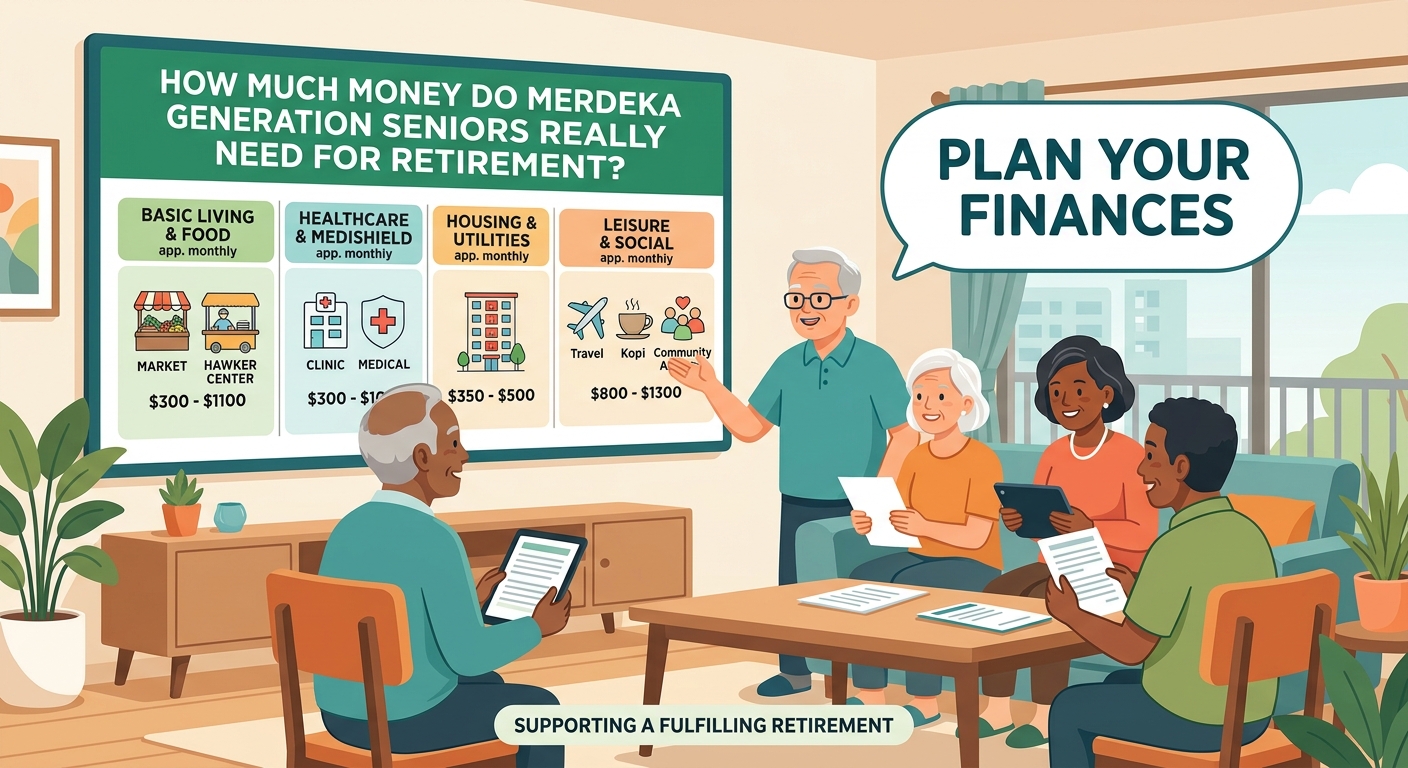
    Three realistic retirement budgets for Singapore seniors

    Let’s break down what different retirement lifestyles actually cost each month.

    Basic lifestyle: $1,500 to $2,000 monthly

    This covers essentials without frills. You eat most meals at home, use public transport, and rely heavily on subsidised healthcare. Entertainment means free community centre activities and neighbourhood coffee shop gatherings.

    Your monthly breakdown looks like this:

    • Food and groceries: $400 to $500
    • Utilities and phone: $150 to $200
    • Transport: $80 to $120
    • Healthcare and medication: $200 to $300
    • Personal care and household items: $150
    • Miscellaneous: $200

    Moderate lifestyle: $2,000 to $3,000 monthly

    You dine out occasionally, take taxis when needed, and enjoy regular activities with friends. Healthcare includes some private specialist visits beyond subsidised options.

    • Food and dining: $600 to $800
    • Utilities and phone: $200
    • Transport: $150 to $200
    • Healthcare: $300 to $500
    • Entertainment and hobbies: $250
    • Personal care: $200
    • Gifts and family support: $200
    • Miscellaneous: $300

    Comfortable lifestyle: $3,000 to $4,500 monthly

    Regular restaurant meals, weekend activities, occasional holidays to Malaysia or regional destinations, and comprehensive private healthcare coverage define this tier. You maintain social commitments and support family members financially.

    • Food and dining: $1,000 to $1,200
    • Utilities and phone: $250
    • Transport including occasional private hire: $300 to $400
    • Healthcare including private insurance: $500 to $800
    • Travel and leisure: $500
    • Entertainment: $300
    • Gifts and family: $400
    • Personal care: $250
    • Miscellaneous: $400

    Calculating your total retirement fund

    How Much Money Do Merdeka Generation Seniors Really Need for Retirement in Singapore? — image 1

    Three methods help you estimate how much you need saved before retirement.

    Method 1: Annual expenses multiplied by retirement years

    Take your expected monthly spending, multiply by 12, then multiply by your estimated retirement duration.

    If you plan to spend $2,500 monthly and expect to live 25 years after retirement:

    $2,500 × 12 months × 25 years = $750,000

    This simple calculation gives you a baseline figure. It assumes zero investment returns and doesn’t account for CPF payouts or government support.

    Method 2: The 25 times rule

    Multiply your annual expenses by 25. This follows the 4% safe withdrawal rate principle, meaning you withdraw 4% of your savings annually.

    Annual expenses of $30,000 × 25 = $750,000

    This method assumes your remaining capital continues earning returns that roughly match inflation.

    Method 3: Income replacement ratio

    Aim to replace 60% to 80% of your pre-retirement income. If you earned $3,500 monthly before retiring, target $2,100 to $2,800 monthly during retirement.

    Most retirees need less than their working income because CPF contributions stop, work-related expenses disappear, and housing loans are typically paid off.

    Government schemes that reduce your retirement burden

    Merdeka Generation seniors enjoy several benefits that lower actual out-of-pocket costs.

    Merdeka Generation Package benefits

    The package provides substantial healthcare subsidies that reduce your medical expenses significantly. You receive:

    • $200 annual PAssist top-up for outpatient costs
    • Additional subsidies at polyclinics and public hospitals
    • MediShield Life premium subsidies
    • CHAS card benefits for GP visits

    These benefits alone save you $1,000 to $2,000 yearly on healthcare. If you haven’t confirmed your eligibility yet, checking if you qualify for the Merdeka Generation Package takes just minutes online.

    CPF LIFE monthly payouts

    Your CPF LIFE provides guaranteed monthly income for life. Payout amounts depend on your retirement account balance at age 65.

    CPF Retirement Account Balance Estimated Monthly Payout
    $100,000 $870 to $960
    $200,000 $1,740 to $1,920
    $300,000 $2,610 to $2,880

    These figures use current payout estimates and vary based on the CPF LIFE plan you selected. The Standard Plan offers higher initial payouts, while the Escalating Plan starts lower but increases over time to combat inflation.

    Understanding whether you can withdraw your CPF savings at 65 helps you plan better because only amounts above the Full Retirement Sum become available for withdrawal.

    Silver Support Scheme

    If you earned low wages throughout your working life, the Silver Support Scheme provides quarterly cash payouts. Eligible seniors receive $300 to $750 every quarter based on their income history and property ownership.

    This adds $1,200 to $3,000 annually to your retirement income without any application required. The government automatically assesses eligibility.

    Healthcare costs deserve special attention

    How Much Money Do Merdeka Generation Seniors Really Need for Retirement in Singapore? — image 2

    Medical expenses typically increase as you age, and healthcare inflation runs higher than general inflation.

    Planning for rising medical costs

    Healthcare inflation in Singapore averages 4% to 6% annually, compared to general inflation of 2% to 3%. A medical procedure costing $5,000 today could cost $9,000 in 15 years at 4% annual inflation.

    Your MediShield Life covers major hospital bills, but you still pay deductibles and co-insurance. Maximising your MediShield Life coverage means understanding what’s covered and what requires out-of-pocket payment.

    Using your Medisave wisely

    Your Medisave account helps pay for approved medical treatments, hospitalisation, and certain outpatient procedures. The key is knowing how much Medisave you need and using it wisely rather than depleting it too quickly.

    Budget $3,000 to $5,000 annually for healthcare costs not covered by insurance or subsidies. This includes dental work, spectacles, traditional Chinese medicine, and medications not covered by standard schemes.

    “Many retirees underestimate healthcare spending in their later years. Budget conservatively and keep a healthcare emergency fund of at least $20,000 separate from your regular retirement savings. Medical surprises happen, and having dedicated funds prevents you from depleting your core retirement nest egg.” – Financial planning advisor

    Common retirement planning mistakes to avoid

    Mistake Why It Hurts Better Approach
    Ignoring inflation Your $2,000 monthly budget today needs $3,200 in 20 years at 2.5% inflation Increase budget estimates by 2.5% to 3% annually
    Counting on inheritance Property or family support may not materialise as expected Plan as if you receive nothing extra
    Underestimating lifespan Running out of money at 85 when you live to 92 creates hardship Plan for age 90 or 95, not 80
    Withdrawing CPF too early Spending lump sums quickly leaves nothing for later years Keep funds in CPF LIFE for guaranteed income
    Skipping regular reviews Your needs and costs change every few years Review spending and adjust plans every 3 years

    Many Merdeka Generation seniors also make common mistakes when claiming benefits that cost them money unnecessarily.

    Building your personal retirement number

    Follow these steps to calculate your specific retirement fund target.

    Step 1: Track current monthly spending

    Record everything you spend for three months. Use your bank statements, receipts, and cash withdrawals to build an accurate picture. Many retirees discover they spend 20% more than they thought.

    Step 2: Adjust for retirement lifestyle changes

    Some costs disappear after retirement. Work clothes, daily commute expenses, and lunch at the office all stop. But other costs might increase. Healthcare, hobbies, and leisure activities often take up more of your budget.

    Add 10% to 15% as a buffer for unexpected expenses.

    Step 3: Factor in government support

    Subtract your expected CPF LIFE monthly payout from your target monthly spending. Then subtract any Silver Support payments if eligible.

    If you need $2,500 monthly and receive $1,500 from CPF LIFE, you need to generate $1,000 monthly from other sources.

    Step 4: Calculate total savings needed

    Multiply your monthly shortfall by 12 months, then by 25 years. This gives you the lump sum needed to generate that monthly income.

    $1,000 × 12 × 25 = $300,000

    Step 5: Add healthcare reserve

    Add $50,000 to $100,000 as a dedicated healthcare fund for major medical events not covered by insurance. This sits separate from your regular retirement fund.

    Making up shortfalls before retirement

    If your calculations show a gap between what you have and what you need, several strategies help close it.

    Extending your working years

    Working even two to three extra years dramatically improves retirement readiness. You contribute more to CPF, give existing savings more time to grow, and reduce the number of retirement years you need to fund.

    Singapore’s re-employment age lets you work until 67, and many employers offer flexible arrangements for experienced workers.

    Topping up your CPF

    CPF top-ups earn guaranteed returns and increase your CPF LIFE payouts. You can top up using cash or transfer funds between CPF accounts. The question of whether you should top up your CPF LIFE after 65 depends on your liquidity needs and other income sources.

    Rightsizing your housing

    Selling a larger flat and moving to a smaller one releases housing equity. The proceeds boost your retirement savings while reducing maintenance costs and property tax.

    The Lease Buyback Scheme lets you sell part of your flat lease back to HDB while continuing to live there, providing both cash and monthly income.

    Reducing fixed expenses

    Review insurance policies, subscriptions, and recurring payments. Cancel what you don’t use. Negotiate better rates on utilities and phone plans. Small monthly savings compound over decades.

    Special considerations for Merdeka Generation couples

    If both spouses qualify for Merdeka Generation benefits, you enjoy double the healthcare subsidies and PAssist top-ups. This significantly reduces household medical expenses.

    However, planning gets trickier when only one spouse qualifies for the package. The non-qualifying spouse needs separate healthcare budget allocation.

    Budget for two people carefully. While some expenses like housing remain fixed regardless of household size, food, healthcare, and personal costs nearly double.

    Plan for the possibility that one spouse outlives the other by 5 to 10 years. The surviving spouse needs sufficient funds to maintain their lifestyle alone, often with higher healthcare costs.

    Understanding your annual top-ups and subsidies

    Your annual $200 PAssist top-up arrives automatically in your CHAS card. This covers GP visits, dental care, and other approved outpatient services.

    Track your subsidy usage throughout the year. If you consistently have unused balance, you’re leaving benefits on the table. If you regularly exceed it, budget more for healthcare.

    The CHAS card benefits extend beyond the Merdeka Generation top-up, providing subsidies at participating clinics even after you use up your annual allocation.

    What happens if you move overseas

    Some retirees consider relocating to lower-cost countries like Malaysia or Thailand where their Singapore dollars stretch further. But moving overseas affects your Merdeka Generation benefits in specific ways.

    Your CPF LIFE payouts continue regardless of where you live. However, healthcare subsidies only apply at Singapore facilities, making them useless if you permanently relocate.

    Weigh the cost savings of living abroad against losing access to subsidised Singapore healthcare. Medical tourism works for planned procedures, but emergency care and ongoing treatment become complicated when you live overseas.

    When healthcare claims get rejected

    Understanding what to do when your healthcare subsidy claim gets rejected prevents financial surprises. Common rejection reasons include visiting non-participating clinics, claiming for non-covered services, or administrative errors.

    Keep all medical receipts and documentation. Appeal rejected claims promptly with supporting evidence. Many rejections get overturned when you provide proper documentation.

    Protecting your benefits and identity

    Keep your Merdeka Generation card safe. If you misplace it, knowing what happens when you lose your card helps you get a replacement without losing access to benefits.

    Never share your card details, NRIC number, or bank information with anyone claiming to help you claim benefits. Government agencies never ask for bank passwords or request money transfers over the phone.

    Adjusting your plan as circumstances change

    Review your retirement budget every two to three years. Inflation, changing health needs, and lifestyle adjustments all affect your actual spending.

    If you consistently underspend your budget, you can afford small lifestyle upgrades or increase financial gifts to family. If you overspend, identify areas to cut back before depleting savings too quickly.

    Track your account balances quarterly. Seeing your nest egg shrink faster than expected signals the need for immediate adjustments.

    Your retirement timeline starts now

    The retirement savings you need depend entirely on the lifestyle you want and the years you need to fund. Basic living requires $300,000 to $400,000 beyond CPF payouts. Moderate comfort needs $500,000 to $700,000. Comfortable retirement with travel and flexibility demands $800,000 or more.

    Merdeka Generation benefits reduce your burden by thousands of dollars yearly, but they don’t eliminate the need for personal savings. Healthcare costs climb as you age, inflation erodes purchasing power, and unexpected expenses always appear.

    Start by calculating your specific number using your actual spending patterns. Factor in CPF LIFE payouts, government subsidies, and healthcare reserves. Then work backward to determine whether your current savings trajectory gets you there.

    The gap between where you are and where you need to be gets easier to close the earlier you start. Even small monthly adjustments compound significantly over years. Your retirement security depends on realistic planning today, not optimistic hoping for tomorrow.