
Getting a rejection letter for your healthcare subsidy or insurance claim feels like a punch to the gut. You followed the rules, submitted the forms, and expected the coverage you’re entitled to. Now you’re stuck with a bill and a confusing explanation that doesn’t make sense.
When your health insurance claim or subsidy gets denied, don’t panic. Most rejections happen due to paperwork errors, missing documents, or misunderstood eligibility rules. You have the right to appeal within specific timeframes. Gather your medical records, understand the exact denial reason, contact your insurer or subsidy provider immediately, and follow their formal appeal process. Many denials get overturned with proper documentation.
Why healthcare claims and subsidies get rejected
Understanding the reason behind your rejection is the first step to fixing it.
Most denials fall into a few common categories. Your claim might have been flagged for incomplete information. Perhaps your doctor’s referral letter didn’t include specific details the insurer needed. Or the treatment code on your bill doesn’t match what your policy covers.
Timing issues cause plenty of rejections too. You might have submitted your claim after the deadline. Some policies require pre-approval for certain procedures, and going ahead without it triggers an automatic denial.
Eligibility problems are another major culprit. If you’re applying for Merdeka Generation subsidies but the system shows you don’t meet the age criteria, your claim gets rejected. Sometimes it’s just a database error, but you need to prove your eligibility.
Here are the most frequent rejection reasons:
- Missing or incomplete medical documentation
- Treatment not covered under your policy or subsidy scheme
- Late submission past the claim deadline
- Pre-approval not obtained before treatment
- Eligibility criteria not met or not verified
- Billing codes that don’t match approved procedures
- Duplicate claims already processed
- Policy lapsed or premium payments overdue
Steps to take immediately after receiving a denial
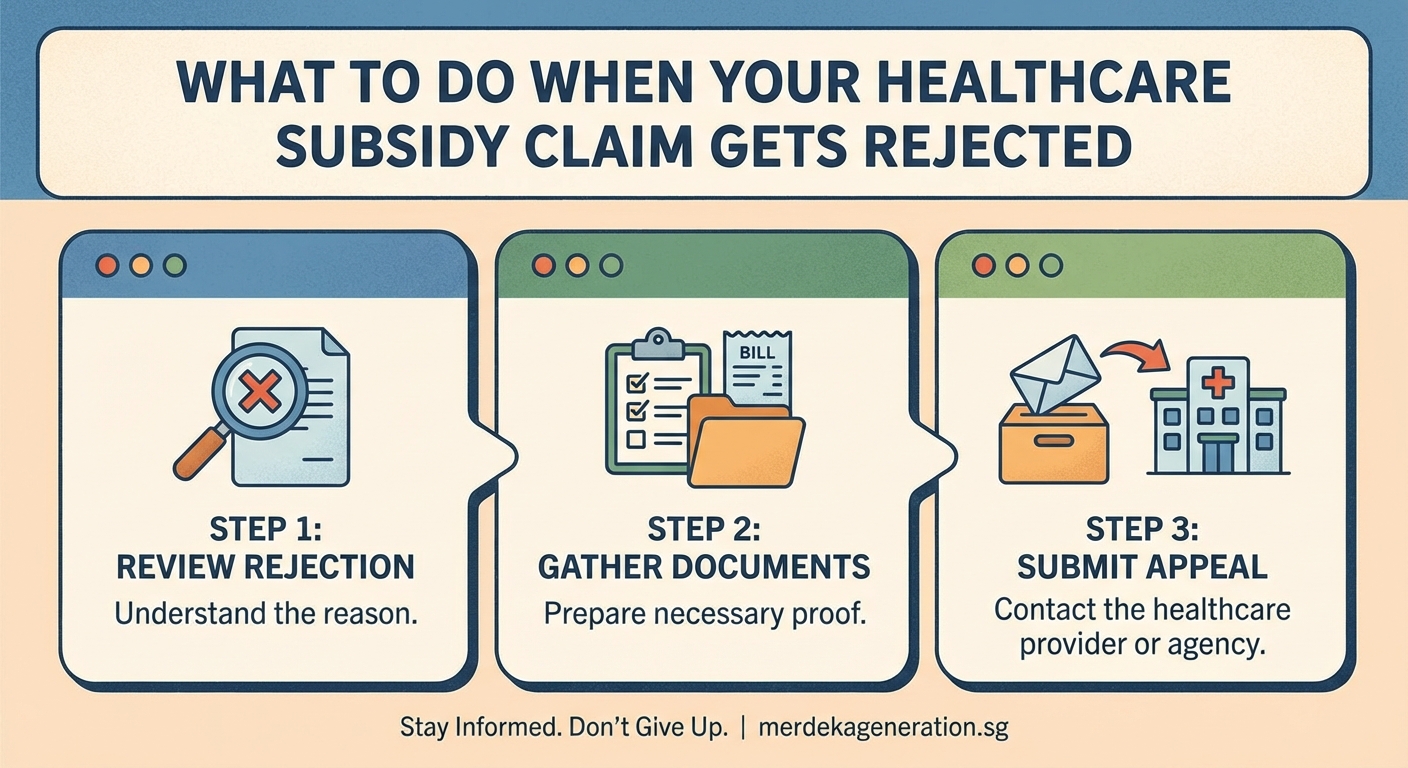
Time matters when dealing with rejections. Most appeal windows are tight.
Step 1: Read the rejection letter carefully
Your denial notice contains crucial information. Look for the specific reason code or explanation. Check the date by which you must file an appeal. Note the contact person or department handling your case.
Don’t skip the fine print. Sometimes the letter includes forms you need to complete or documents you must provide.
Step 2: Contact your provider or insurer right away
Call the number on your rejection letter. Ask for clarification on anything you don’t understand. Request a detailed explanation of why your claim was denied.
Take notes during the call. Write down the name of the person you spoke with, the date, and what they told you. This documentation helps if you need to escalate later.
Step 3: Gather all relevant documents
Pull together every piece of paper related to your claim. This includes your original application, medical receipts, doctor’s letters, referral notes, and any correspondence with the insurer or government agency.
If you’re claiming Merdeka Generation subsidies, make sure you have proof of eligibility. Your Merdeka Generation card, NRIC, and any verification letters should be in your file.
Step 4: Check your policy or subsidy terms
Go back to your insurance policy document or the official Merdeka Generation Package guidelines. Verify whether the treatment or service should actually be covered.
Sometimes what seems like an error is actually a legitimate exclusion you missed. Other times, you’ll find clear evidence that the denial was wrong.
Step 5: Submit your appeal within the deadline
Most insurers give you 30 to 90 days to appeal. Government subsidy programs have their own timelines. Missing the deadline usually means losing your right to challenge the decision.
Follow the exact appeal process outlined in your rejection letter. Use the correct forms, submit to the right address or email, and include all supporting documents.
Step 6: Follow up regularly
Don’t assume your appeal is being processed just because you sent it. Call or email every week to check the status. Keep records of every interaction.
Persistence pays off. Many claims get resolved simply because someone kept asking.
How to write an effective appeal letter
Your appeal letter needs to be clear, factual, and persuasive.
Start with your personal details: name, policy number or subsidy ID, claim number, and contact information. State clearly that you’re appealing the denial dated [specific date].
Explain why you believe the denial was incorrect. Reference specific policy clauses or subsidy guidelines that support your position. Attach copies of all supporting documents.
“Keep your appeal letter professional and focused on facts. Emotional language rarely helps. Stick to what the policy says, what documentation proves, and why the denial doesn’t align with the terms you agreed to.”
Include a timeline of events if relevant. For example, if you were told verbally that a treatment was covered, mention that conversation and any follow-up you did.
End with a clear request: “I am requesting that you reverse the denial and approve my claim for [specific amount] based on the evidence provided.”
Common mistakes that lead to rejected appeals
Even people with valid claims lose appeals because of avoidable errors.
| Mistake | Why It Hurts Your Case | How to Avoid It |
|---|---|---|
| Submitting incomplete documentation | Gives the reviewer an easy reason to deny again | Create a checklist of required documents before sending |
| Missing the appeal deadline | Automatic rejection regardless of merit | Mark the deadline on your calendar immediately |
| Not addressing the specific denial reason | Reviewer thinks you didn’t understand the issue | Quote the exact denial reason in your appeal |
| Using emotional or aggressive language | Makes reviewers less sympathetic | Stay professional and factual throughout |
| Failing to provide medical necessity proof | Insurer can claim treatment was optional | Get a detailed letter from your doctor explaining why treatment was necessary |
| Submitting duplicate or contradictory information | Raises red flags about claim validity | Review all documents for consistency before submission |
Understanding your rights as a healthcare consumer
You have more protection than you might realize.
In Singapore, insurance companies must follow guidelines set by the Monetary Authority of Singapore. They’re required to handle claims fairly and respond to appeals within reasonable timeframes.
For government subsidies like the Merdeka Generation Package, you can escalate to the relevant ministry if you believe you’ve been treated unfairly. The process is transparent, and officials are required to review your case properly.
If your insurer repeatedly denies valid claims or fails to follow their own procedures, you can file a complaint with the Financial Industry Disputes Resolution Centre. This independent body helps resolve disputes between consumers and financial institutions.
For subsidy-related issues, the Ministry of Health has channels for feedback and appeals. Don’t hesitate to use them if you’re not getting answers through normal channels.
Special considerations for Merdeka Generation subsidies
Merdeka Generation members have specific benefits that sometimes get confused with general healthcare subsidies.
Your Merdeka Generation Package includes subsidies for outpatient care, MediShield Life premiums, and long-term care. Each component has different eligibility rules and claim processes.
If your subsidy claim gets rejected, check whether you’re actually eligible for that specific benefit. For instance, the outpatient care subsidies work differently from the MediShield Life premium subsidies.
Sometimes rejection happens because the clinic or hospital didn’t properly verify your Merdeka Generation status at the point of service. If you showed your card but the subsidy wasn’t applied, contact the healthcare provider first. They may need to resubmit the claim with correct coding.
Lost your Merdeka Generation card? That could be why your claim was rejected. Get a replacement before trying to claim subsidies.
Common Merdeka Generation subsidy claim issues include:
- Healthcare provider not registered under the scheme
- Services provided outside the covered categories
- Failure to present the Merdeka Generation card during visit
- Database not updated with your eligibility status
- Confusion between Pioneer Generation and Merdeka Generation benefits
The differences between Pioneer and Merdeka Generation packages matter. Make sure you’re claiming the right benefits for your generation.
When to escalate beyond the initial appeal
Sometimes your first appeal doesn’t work. That doesn’t mean you’re out of options.
If your appeal gets denied again, request a detailed written explanation. Ask specifically which policy clause or regulation supports their decision. This information helps you decide whether to escalate further.
For private insurance, your next step is usually an internal review at a higher level within the company. Request this in writing and provide any additional documentation you’ve gathered.
If internal reviews don’t resolve the issue, external dispute resolution becomes necessary. The Financial Industry Disputes Resolution Centre handles cases where insurers and policyholders can’t reach agreement. There’s a small fee, but it’s worth it for significant claims.
For government subsidies, escalate to the supervising ministry. Write a formal letter explaining your situation, what you’ve tried so far, and why you believe the rejection is incorrect. Include copies of all correspondence and supporting documents.
How to prevent future claim rejections
Learning from a rejection helps you avoid the same problem next time.
Always verify coverage before receiving treatment. Call your insurer or check the subsidy guidelines online. Get written confirmation if possible.
Keep meticulous records. Save every receipt, every letter from your doctor, and every form you submit. Take photos of documents before mailing them.
Submit claims promptly. Don’t wait until the last minute. Early submission gives you time to fix problems if something’s missing.
Understand your policy inside and out. Read the fine print at least once. Know what’s covered, what’s excluded, and what requires pre-approval.
For Merdeka Generation benefits, stay updated on any changes to the package. The government occasionally adjusts eligibility criteria or covered services. Checking your eligibility regularly prevents surprises.
Many seniors make common mistakes when claiming benefits. Learning what these are helps you avoid them.
Getting help with complex cases
Some rejections are too complicated to handle alone.
Patient advocacy services exist to help people navigate insurance and subsidy systems. Some hospitals have patient relations officers who can assist with claim issues.
Community organizations serving seniors often provide free advice on healthcare subsidies. They understand the Merdeka Generation Package thoroughly and can spot errors in rejections.
If your case involves significant money or ongoing treatment, consider consulting a lawyer who specializes in insurance disputes. The initial consultation fee might save you thousands in denied claims.
Financial counsellors can also help, especially if the rejection affects your ability to pay for necessary care. They can suggest alternative funding sources or payment plans while you appeal.
What to do while waiting for your appeal decision
Don’t let the appeal process delay necessary treatment.
If you need ongoing care, continue receiving it. Work out a payment plan with your healthcare provider if needed. Many clinics and hospitals are willing to defer payment while insurance issues get resolved.
Keep all new receipts and documentation. If your appeal succeeds, you’ll need these to get reimbursed for treatments you paid for out of pocket.
Stay on top of your appeal status. Set reminders to follow up every week. The squeaky wheel really does get the grease in these situations.
If financial pressure is mounting, look into additional healthcare subsidies you might qualify for. These can provide relief while your main claim is being resolved.
Consider whether maximizing your MediShield Life coverage could prevent similar issues in future.
Making the system work for you
Rejected claims feel personal, but they’re usually just administrative hiccups.
The healthcare and insurance systems in Singapore have multiple safety nets built in. Appeals exist because mistakes happen. Reviewers understand that paperwork gets confusing, especially for complex government schemes.
Your persistence matters more than anything else. People who follow up consistently and provide thorough documentation usually get their legitimate claims approved eventually.
Don’t let one rejection discourage you from claiming benefits you’ve earned. The Merdeka Generation Package exists to support you. Government subsidies and insurance coverage are your rights as a policyholder and citizen.
Take it one step at a time. Read the rejection letter, gather your documents, write your appeal, and follow up. Most claims that deserve approval eventually get it.
Stay organized, stay patient, and don’t give up on money that rightfully belongs to you.
Leave a Reply