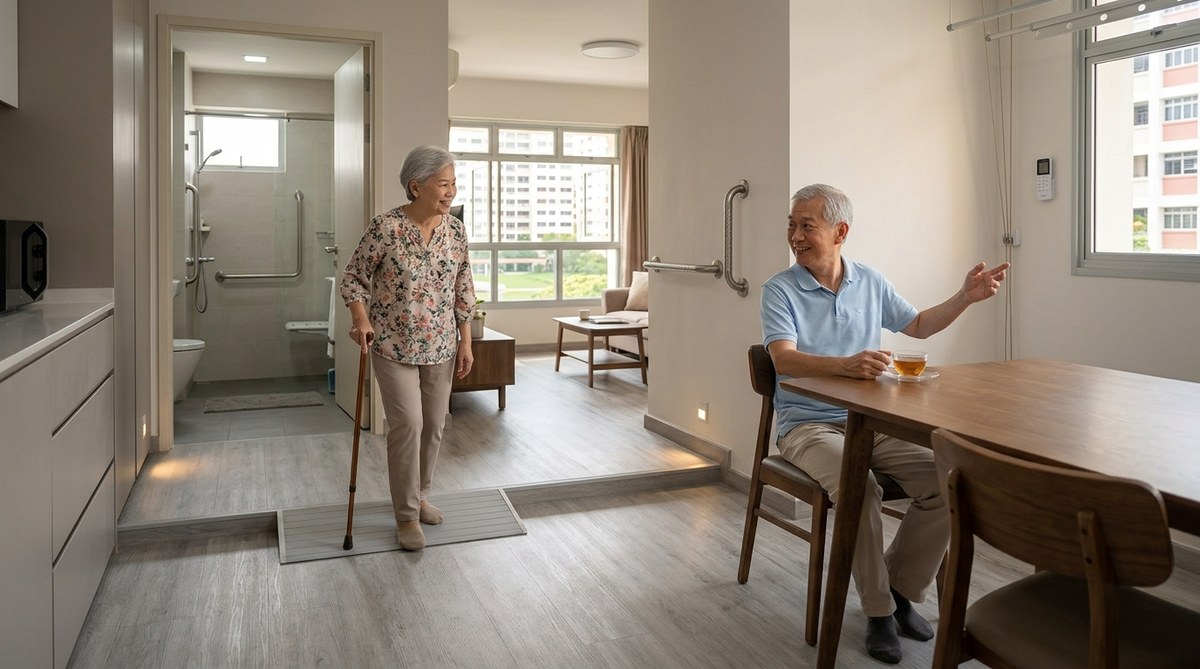
Your HDB flat has been your home for decades. The children grew up here, you celebrated many CNY dinners in the living room, and the neighbourhood kopitiam knows your regular order. But as you or your parents get older, that same flat can start to feel less safe. The step into the shower feels higher. The corridor to the kitchen seems narrower. The thought of a fall becomes a real worry. The good news is you do not need to move out. With some smart modifications, your existing home can support you safely through the years ahead.
Retrofitting an HDB flat for aging in place does not have to be expensive or disruptive. Focus on a few high-impact areas: the bathroom, the entrance, and flooring. The Enhancement for Active Seniors (EASE) programme can subsidise up to 95% of costs for eligible households. Plan ahead based on current and future mobility needs, and always engage an HDB-approved contractor to ensure safety and compliance.
Why Consider an HDB Aging in Place Retrofit
Aging in place means living in your own home safely, independently, and comfortably, regardless of age or mobility level. For many Singaporean seniors, the Merdeka Generation, moving to a nursing home or a relative’s flat is not appealing. You know your neighbours. You know which lift lobby has the best breeze. Staying put preserves your social connections and your sense of independence.
Beyond emotional comfort, practical reasons matter. The cost of retrofitting is often far lower than selling and buying a smaller flat or moving into a senior-friendly development. With government support through the your out-of-pocket expenses can be minimal. A retrofit can prevent falls, which are the leading cause of hospitalisation among seniors in Singapore. A safer home means fewer trips to the A&E and more peace of mind for everyone.
Step 1: Assess Your Current and Future Needs
Before buying grab bars or removing bathtubs, take stock. Start with a walkthrough of your flat with a critical eye. Better yet, ask a family member or an occupational therapist to help. They spot hazards you might overlook because you are used to them.
Checklist for a Home Safety Audit
- Are there any loose rugs or uneven floor tiles that could trip someone?
- Can you stand and move freely in the bathroom, especially near the toilet and shower?
- Do doorways allow a walker or wheelchair to pass through comfortably?
- Is the lighting adequate, especially at night, from bedroom to toilet?
- Are kitchen counters at a height that avoids excessive bending or reaching?
- Do you have a step to enter the shower area?
Use this audit to create a priority list. For example, if the bathroom floor gets slippery when wet, that becomes a high priority. If the kitchen counter height is fine now but may become an issue in five years, you can plan a medium-term fix.
Step 2: Understand Available Grants and Schemes
Singapore’s government has several schemes to help seniors retrofit their HDB flats. The most important is the Enhancement for Active Seniors (EASE) programme. HDB offers this subsidy for a fixed set of modifications. Eligible households can receive up to 95% subsidy, depending on income.
Key Grants at a Glance
| Grant / Scheme | What It Covers | Subsidy Level | Eligibility |
|---|---|---|---|
| EASE (HDB) | Grab bars, slip-resistant flooring, ramps, widening of doorways | Up to 95% for lower-income; 87.5% for others | Singapore citizen, HDB flat, at least one occupant aged 65+ or 60+ with mobility needs |
| Seniors’ Mobility and Enabling Fund (SMF) | Assistive devices like walking frames, wheelchairs, commodes | Up to 90% subsidy, capped at amounts | Singapore citizen, means-tested, referred by healthcare professional |
| Ageing-in-Place Programme (AIP) | Comprehensive retrofitting beyond EASE (e.g., kitchen, full bathroom remodel) | Variable grants depending on flat type and income | Must be EASE-eligible and living in selected HDB estates |
“We often tell families to start with the bathroom because that is where most falls happen. Even simple changes like a raised toilet seat and a grab bar can prevent a hip fracture.” – Occupational therapist from a Singapore public hospital
Do not forget the Merdeka Generation seniors may qualify for additional healthcare subsidies that can cover the cost of consultations or therapy that inform your retrofit plans.
Step 3: Choose High-Impact Modifications
You do not need to overhaul the entire flat. Focus on the areas that pose the highest risk. Here is a numbered list of the most effective modifications, ranked by impact on safety.
- Install grab bars in the bathroom. Place them near the toilet and inside the shower. Steel or stainless steel grab bars that can support at least 200 kg are ideal. Make sure they are anchored into wall studs or installed with heavy-duty fixings.
- Replace slippery flooring. In bathrooms and kitchen, use slip-resistant tiles. For the rest of the flat, avoid high-pile carpets. Flat, non-slip vinyl or laminate is a good choice. Remove any loose rugs.
- Widen doorways. Standard HDB doorways can be too narrow for a wheelchair or walker. Widening them to at least 760 mm (about 30 inches) makes a big difference. This can be done during EASE renovations.
- Improve lighting. Add night lights along the path from bedroom to toilet. Use motion-sensor lights so you do not have to fumble for a switch. Brighten dark hallways with LED strips.
- Create a level entry. If you have a step at the main door or into the bathroom, install a small ramp or reduce the step height. Even a 2 cm difference can be a trip hazard.
- Raise toilet seats. A higher toilet seat (about 400–430 mm) reduces the effort to sit down and stand up. Many affordable add-on seats are available.
- Add a shower commode chair or fold-down seat. This allows showering while seated, greatly reducing fall risk.
Step 4: Find a Trusted Contractor
HDB has a list of approved contractors for EASE works. Stick to them. They understand HDB structural requirements and guarantee workmanship. If you need additional retrofitting beyond EASE (for example, a full kitchen redesign), look for contractors experienced with universal design. Ask for references or photos of past projects.
What to Ask a Contractor
- Are you familiar with HDB guidelines for elderly safety modifications?
- Can you provide a detailed quotation including all materials and labour?
- Do you help with grant applications or provide the necessary documentation?
- How long will the work take? What measures do you take to minimise dust and disruption?
Step 5: Create a Timeline and Budget
Some retrofitting can happen over a weekend. Other jobs require coordination with neighbours, especially if there is noisy renovation work. Plan around major holidays or family events.
Sample Budget for a Basic EASE Retrofit
| Modification | Estimated Cost before Grant | After 87.5% Subsidy (For Homeowner above PCHI threshold) |
|---|---|---|
| Grab bars (set of 3) | $400 | $50 |
| Slip-resistant flooring in bathroom & toilet | $600 | $75 |
| Ramps for main entrance and bathroom | $300 | $37.50 |
| Widening of one doorway | $500 | $62.50 |
| Total | $1,800 | $225 |
Numbers are rough estimates and change yearly. Check the https://merdekageneration.sg/scheme-updates-guide/ for current figures.
Common Mistakes to Avoid
Even with good intentions, people make errors. Here are pitfalls to watch for, and how to steer clear.
| Mistake | Why It Is a Problem | Better Approach |
|---|---|---|
| Installing grab bars in wrong location | They end up too far to reach or mounted on hollow wallboard | Have an occupational therapist mark positions before drilling |
| Choosing cheap non-slip mats | They can curl up at edges, causing trips | Invest in fixed slip-resistant floor tiles or sheets |
| Forgetting about lighting | Dim corridors remain hazardous even with grab bars | Install automatic night lights along the main path |
| Overdoing changes too soon | Unnecessary expense may reduce resale appeal or aesthetics | Prioritise high-risk areas first; leave cosmetic upgrades for later |
Making Your Retrofit Sustainable
A good retrofit does not just solve today’s problems. It also adapts to future needs. For example, if you install grab bars now, leave space so that a caregiver can assist later. Choose lever handles instead of round doorknobs; they are easier for arthritic hands. Consider a built-in shelf in the shower for toiletries at a reachable height.
Remember that aging in place is not only about physical safety. It involves social and financial well-being too. The https://merdekageneration.sg/top-senior-friendly-housing-options-in-singapore-for-comfortable-aging/ article explores other housing choices if retrofitting is not enough.
Final Steps: Putting the Plan into Action
You now have a clear roadmap. Let us summarise the steps:
- Perform a home safety audit with a family member or professional.
- Check your eligibility for EASE and other subsidies.
- Decide on two or three high-impact modifications to start.
- Book an approved contractor through HDB.
- Arrange the work timeline to minimise disruption.
- Test the changes and adjust as needed.
A single fall in the bathroom can change your life. A simple grab bar and a night light can prevent that fall. Do not wait until an accident happens. Start planning your retrofit this year.
If you are also managing other aspects of retirement finances, read our guide on https://merdekageneration.sg/should-you-downsize-your-hdb-flat-for-extra-retirement-cash/ for a broader view of housing choices. And if you need healthcare subsidy support, the https://merdekageneration.sg/how-much-can-you-actually-save-on-polyclinic-visits-with-merdeka-generation-subsidies/ article can help you save more.
Your home should be your sanctuary, not a hazard. With the right modifications, you can enjoy many more years of comfort, independence, and safety in the flat you love.
Leave a Reply